Showing posts with label Biography. Show all posts

Tuesday, December 29, 2009

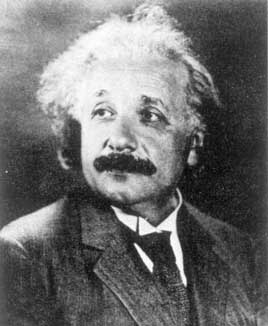
Albert Einstein


b. 14 March 1879
d. 18 April 1955

I will not attempt to explain the contributions that Einstein made to physics in this little biographical sketch. For one thing, I don't understand the majority of what he wrote. For another, I would like to focus instead on his character and life as an interesting and important glimpse into his mind.

Though born in Germany, Einstein did not die a citizen thereof. In fact, he renounced his citizenship for the small price of three German marks and became a naturalized citizen of Switzerland five years later, paying twenty francs. The price of his citizenship notwithstanding, national affiliation was extremely important to him. He both detested and rejected the nationalistic and militaristic government of Germany and embraced the peaceful attitude of Switzerland. To the end of his life, Einstein remained a pacifist, conceding only that military force should be used to combat institutions which "pursue the destruction of life as an end in itself."

He further hated the German educational system which consisted of rote studies and a particular deference to authority. Though it is often stated that Einstein was a poor student, the more accurate statement is that he did not thrive in the stifling classroom being forced into a discipline in which he was not naturally engaged.

In fact, after being rejected from the Zürich Polytechnic Institute, Einstein spent a year in Aarau, Switzerland where he succeeded in a flexible education with a casual teacher who allowed Einstein a liberty of thought that was necessary for his future discoveries. About the necessity of such liberty he wrote that "it is, in fact, nothing short of a miracle that the modern methods of instruction have not yet entirely strangled the holy curiosity of inquiry; for this delicate little plant, aside from stimulation, stands mainly in need of freedom."

His ability to thrive in a self-determined schedule accounts for his eventual success at the Zürich Poly (having been accepted after a second application). He largely ignored his classes, showing up only for the exams which he passed due to the copious notes of his studious friend Marcel Grossmann. After graduation, Einstein found his desired freedom in an unlikely place. He was refused a position as an assistant at the Zürich Poly (perhaps due to some underhanded manipulation by a professor who disliked him) and accepted a job at the Bern Patent Office in 1902 where he was assigned to read and approve patent applications. The job proved useful, however, in that it was not difficult. He spent his spare time theorizing and conducting gedankenexperiemnts (literally: thought experiments) which are designed to prove a principle without actually having to conduct the experiment physically.

Einstein was so successful in this free environment that he published three papers in the 1905 edition of Annalen der Physik each on a different subject. The first, for which he eventually won a Nobel Prize, explained the connection between the photoelectric effect and quantum mechanics. The second paper treated molecular behavior. The third was his inspired explanation of relativity which gave rise to spacetime. To restate for emphasis, during seven years working as a patent clerk, Einstein published—among others—a Nobel Prize winning paper and the foundational paper for the most (culturally) famous development in science.

Inevitably, Einstein was noticed by the scientific community. He subsequently worked in Berlin at the Prussian Ministry of Education with Max Planck (a great scientist in his own right who wrote of him, "All in all, one can say that among the great problems, so abundant in modern physics, there is hardly one to which Einstein has not brought some outstanding contributions.") and at Princeton. But the former was overrun with Nazis and the latter boring yet peaceful enough for him to, as he wrote to the Queen of Belgium with whom he had apparently frequent correspondence, "create for [himself] an atmosphere conducive to study . . . free from distraction."

He was married twice. And though the first marriage failed due probably to a lack of attention to his family in favor of scientific pursuits, he remained supportive of his first wife and children, sending them his prize money after receiving the Nobel Prize in 1921 (two years after his marriage to his second wife, Elsa). Elsa was described as "gentle, warm, motherly, and prototypically bourgeoisie." She enjoyed the fame of her husband's publications and tolerated his absence and distractions.

Notably, Einstein's genius was not happened upon, nor was it easy to obtain. Though none can deny his natural ability in theoretical physics, the secret to his success was work. Though some concepts eventually unfolded before him, others such as his Unified Field Theory never came to fruition. Yet he never ceased his work nor became discouraged. "After all," he wrote, "to despair makes even less sense than to strive for an unattainable goal." Three months before he died, Abraham Pais, one of Einstein's biographers, visited him at home and spoke with him for a half an hour. Einstein had been at his desk working when Pais entered and before Pais was able to leave (a journey of approximately five steps), Einstein was hunched over his desk "oblivious to his surroundings" yet again.

Now, fifty years after his death, Einstein remains one of the most well known names in scientific and even in common history. His developments in theoretical physics, along with those of Planck, de Broglie, Schrödinger and others, laid the groundwork for most if not all of the scientific developments that came thereafter.

Wednesday, July 8, 2009

Isaac Newton


b. 25 December 1624
d. 20 March 1727

Noteworthies:
Everyone has heard of Isaac Newton, and for good reason. He's very much the father of mechanics as well as the reason that we are able to calculate everything the way that we do. I'll get to that a bit later, but let's first talk about his character.

Newton was supremely inquisitive. Even as a child he was extremely curious about his surroundings. He drew pictures, invented tools and appliances, experimented, and was eternally posing questions to himself. Interestingly, he was totally apathetic to school and performed terribly. But either the prospect of having to manage the family estate or an alleged attack from an elementary school bully changed his mind and he eventually got accepted to Cambridge. There, he worked his way through school waiting tables and doing janitorial work until he was accepted on scholarship.

In 1665, the campus was closed for 18 months due to an outbreak of the bubonic plague. Oddly, the year and a half he spent at home was Newton's self-termed annus mirabilis (miraculous year), during which his scientific career exploded. While at home he invented calculus and began solving previously unsolvable problems with apparent ease.

Calculus can be termed as the study of infinitesimal progression. Take a falling ball, for example. Imagine that you took a picture of it one time every second until it hit the ground. Developing the pictures, you could analyze how far the ball fell each second and would probably be able to determine that the ball fell more at the end of its flight than at the beginning. Now imagine that you took a picture of the ball every tenth of a second. Suddenly, you might be able to calculate exactly how much further the ball has fallen in each successive shot (think of making a flip book out of each set of pictures, the one-second pictures would depict a ball with very choppy movement, whereas the other set would show a much smoother trajectory). As the time between successive pictures decreases, so also does the accuracy of our measurement for any given period of time. If it were possible that there was an infinitely small separation between one instant and the next, we would know as much as was possible to know about the falling ball.

This is effectively the concept of calculus. Newton developed a way to take infinitesimally small "pictures" of mathematical situations and was thus able to analyze every single instant from the start of an action to its finish. He developed the idea during what was effectively an overly long summer break. It became an enormously powerful tool.

Another scientist named Robert Hooke once proved a hypothesis made by Kepler that planets travelled in elliptical orbits but refused to share it with his coworkers presumably to avoid having to credit them. The coworkers consulted Newton who replied that he had solved the problem four years prior and simply threw it aside and eventually lost it. He then spent 18 months working furiously to publish before Hooke, at which he succeeded.

Here we encounter another one of Newton's more colorful personality traits: ego. It was perhaps his towering pride that led to his most influential discoveries. Frequently his books were published out of spite for another scientist. Any derogatory remark made about him or his work threw him into a black depression that could only be cured by besting the man who made the comment. As a final blow to his then lifelong enemy, Newton even refused to publish his groundbreaking discoveries in the field of optics until Hooke was dead, thus never revealing to him what had been discovered.

Among the body of scientists at the time, problems were frequently shared so as to facilitate their discovery. Johann Bernoulli once posed the problem of the curves of quickest descent (the Brachistochrone curve), which is the path an object must take between two points that causes it to get there the fastest (hint: it is not a straight line unless one point is directly above the other). Only a few responded, one (Newton) anonymously, as if to say that anyone could solve it. But when Bernoulli read the nameless proof he immediately named Newton as the author proclaiming, "Ah! I know the lion by its paw."

Among other publications, Newton wrote a book known as The Mathematical Principles of Natural Philosophy or Principia for short. It outlines the basic laws governing motion and forces and defines the basic terms that we now consider commonplace (force, mass, velocity, acceleration, inertia, etc.). He proved that all masses are acted upon by gravity in the same way (the moon and an apple, for example), and most importantly, gave us the mathematical tools to solve basically every problem with perfect (yes, perfect) accuracy given the correct conditions. Still, of his own accomplishments, he said, "I do not know how I may appear to the world, but to myself I seem to have been only like a boy, playing on the sea-shore, and diverting myself, in now and then finding a smoother pebble or prettier shell than ordinary, whilst the great ocean of truth lay all undiscovered before me."

Saturday, June 13, 2009

Galileo Galilei


b. 15 February 1564
d. 8 January 1642

Noteworthies:
  • Invented physics
Galileo is one of those people to whom people attribute lots of things just because he was great. In much the same way that Washington did not throw a silver dollar across the Potomac (it being more than a mile across at Mount Vernon) any more than he chopped down a cherry tree on his father's estate, Galileo is largely innocent of all of the one-liner attributions that he is awarded. For instance, he did not invent the telescope (although he was the first to turn it skyward). Equally, he never performed an experiment during which he dropped weights off the Tower in Pisa, thus proving that all masses fall at the same rate. Not surprisingly, he did not really invent physics either. But I'll show you what I meant by that.

Galileo was a student of observation. On top of that, he was sarcastic, confrontational, pugnacious, and brilliant. His mantra was the quest of observable truth and the rejection of "truth" declared in ignorance. His mission was to enlighten those ignorant who trusted their source of truth.

During his time, truth was whatever the Church declared it to be. The Earth was the center of the universe, all things in the heavens were perfectly spherical and traveled in perfect circles, and all unanswerable questions were answered by Church leaders. Galileo's life seems to have been dedicated to breaking the mindset that truth is what men of power think it should be. His methodology was flawless: experimentation and demonstration.

When told (by a Cardinal) that ice floats only because of its sheet-like shape, Galileo performed a public experiment in which he demonstrated that density rules buoyancy. The audience watched as thin sheets of ebony sunk while large blocks of ice remained at the surface. No one could refute the evidence before them.

He was challenged on basically every important discovery he made. When observing the moon through a telescope, he discovered mountains, ridges, and hills. Saturn had "ears" and the Sun had spots. All of these went against the common philosophy that the sky was filled with perfectly circular, perfectly formed bodies. His discoveries were uniformly pronounced untrue until he simply showed his accusers what he had seen with his own eyes.

Again, turning heavenward, Galileo discovered that Venus—like the Moon—displayed phases: crescent, half, full, and back to new. Such a thing could only be possible if it orbited the sun, sometimes lying between us and the Sun, and sometimes being on the other side of the Sun. The Church was scared and frustrated. If a layman could disprove "truths" that had been taught for years by the Church, their authority would be undermined. They arrested him, threatened him with his life, and eventually exiled him. But the damage was done. People started to see that physical truths needed to be observable. Simply declaring a geocentric universe could not make it true. Our declarations must be backed by confirmed fact.

Lest we erroneously think that Galileo's anti-Church stance was anti-religious, let us consider the counsel he gave to his accusers who argued their points from out-of-context Biblical references: "The task of wise interpreters is to find true meanings of scriptural passages that will agree with the evidence of sensory experience." Indeed, his stance was more religious than their own. He maintained that God created a physically explainable world and that part of our reason for being on it was to figure out how it worked. We do not have to deny that God held the Sun in the sky for Joshua, or that He parted the Red Sea just because we can't explain it. But we also do not have to assume that it will remain unexplainable forever.

From his example comes the scientific method. A scientific question asked can only be considered answered when it is backed by repeatable, concrete evidence. The answered question then remains to be further backed by experiment or else disproved by more detailed analysis. The quest is not to be personally right, but to find the truth behind the phenomena that we encounter each day.

Perhaps these stories of Galileo disproving the clergy by experimentation seem trivial. Surely they would have thought to test buoyancy by putting things in water. Isn't that the obvious solution? That sentiment, in and of itself, is a tribute to the great gift that Galileo gave us. We see the simplicity in his methods because we have adopted them through and through. You were raised to experiment, to test, to try, to guess and be wrong, and to reason in part because of the scientific contributions made by an Italian astronomer (of course) several hundred years ago. Someone else probably would have done it if he hadn't been so persistent, but his influence stands out as the catalyst for a reasoning, scientific community that seeks for physical truth by physical confirmation.

Tuesday, May 19, 2009

Enrico Fermi


b. 29 September 1901
d. 28 November 1954

Noteworthies:

  • Nobel Laureate, Physics
  • Namesake of Fermium on the Periodic Table
  • Namesake of Fermi Labs
  • Significant contributor to the Manhattan Project

Fermi, an Italian-born physicist, is probably the most complete physicist since Newton. He was equally and exceptionally gifted in both experimental and theoretical physics and is a contributor to (even arguably the father of) modern nuclear and particle physics. His life and gifts are extraordinary and are worth talking about.

He grew up in Italy, schooled by his mom in their unheated house. It was apparently so cold that he devised a way to turn the pages of his books with his tongue to keep from having to use his hands which he sat on to keep them warm. He was always a great experimenter, using his brother as an assistant. His interest -- or, rather, obsession -- with physics theory came at the tragic and early death of his brother. His first tutor recognized his unique ability to understand and remember physics and math.

"When he read a book, even once, he knew it perfectly and didn't forget it," (1) commented Adolfo Amidei when asked to recollect his student's progress. Later in his life he would even recite whole chapters of physics texts out loud while driving on long trips. His grasp of theory was so concrete that his friends nicknamed him "The Pope" for his infallibility. At college he would often pass his time lying on the grass writing textbooks from memory without any kind of notes or scratch paper. His writings were never interrupted with erased or crossed our words. Often, the director of the research lab where he worked would seek him out (he the student) and say simply, "teach me something." (1)

One of the skills for which Fermi is particularly well known is that of estimation. He possessed the ability to look at a system or a problem and produce remarkably accurate results without any research or calculation except for what was already in his head. When working at Los Alamos labs on the bomb, he accurately estimated the yield (explosive size) of a bomb by dropping scraps of paper as the shock wave passed him. He is also attributed to, without any sort of research or other-than-mental calculation, accurately estimating how many molecules were stripped off of a car tire each rotation, how many piano tuners were in the city of Chicago, and the number of molecules of water in a teaspoon versus the number of teaspoons of water on the planet. These kinds of problems are now actually referred to as Fermi Problems.

His Nobel prize was awarded for his work in nuclear physics, which described the actual process of beta particle emission. For years before, physicists knew that electrons were emitted from atomic nuclei, but were unclear as to where they came from. Fermi determined that a neutron in the nucleus of the atom actually turned itself into a proton by splitting into a proton and an electron-neutrino pair. Inherent in this is the discovery of subatomic particles—quarks—which has led to our knowledge of the history of the universe as well as our current descriptions of the cause of fundamental forces like gravity and magnetism.

He further categorized a class of particles known as fermions which follow certain quantum statistical rules, the understanding of which has led to our comprehension of the behavior of stars, the flow of electricity (and thus, cooper pairs and superconducting materials), which are used every day in current scientific research.

Most notably, Fermi invented or engineered many of the components of elementary nuclear reactors, which now power whole countries (not our own, unfortunately), and the United States Navy's submarines and aircraft carriers. He introduced the cadmium control rods that protect against meltdown during critical-phase nuclear reactions.

Fermi totally immersed himself in every project he undertook, often working around the clock (not because he was under a deadline, but because of his natural interest). He died of stomach cancer at the age of fifty three. "Fermi told [a friend] in 1945, at the end of the war, that he had then completed about one-third of his life's work. By that reckoning, when he died nine years later, Enrico Fermi had given us no more than half of what he had to offer." (1)

1. Cropper, William H., Great Physicists. New York : Oxford University Press, 2001.

Saturday, May 9, 2009

Louis-Victor de Broglie


b. 15 August 1892
d. 19 March 1987

Noteworthies:
  • Nobel Prize laureate
  • Fellow, Académie française
  • Perpetual Secretary, Académie des sciences
  • 7th Duke of Broglie
  • Fellow, Royal Society of London for the Improvement of Natural Knowledge
Born into a rich, aristocratic family, de Broglie (pronounced /də'brɔɪ/) had really no need to become a physicist, or anything else for that matter. His interest in physics came as a combination of natural intuition and skill in the subject and (most probably) from the influence of his older brother, Maurice, who was an accomplished physicist himself. However, his entrance into the field was as well-timed as it was risky.

The last thirty years of science had been revolutionary. Einstein had recently declared light to possess characteristics of both waves and particles, introducing what is now known as wave-particle duality. Planck and Bohr followed up with the discovery of quantization, which is the simply but profound idea that waves (bound energy) can exist only in certain, specific denominations, between which energy propagation is non-existent. Since before, physics had been divided into two separate domains -- particle physics, and wave physics -- duality was something of a hot topic that caused frequent debates. Bohr even refused to believe the results of his own experiments, trying force his findings to fit a (consequently incorrect) model that he couldn't give up.

I know it may seem like a trivial thing to us, but this was groundbreaking work that seemed to be trying to convince the world that apples and oranges were the same thing. De Broglie found himself in the middle of a great schism with Einstein on one side and Bohr on the other. A wrong step could end any credibility he had gained and potentially end his career. Slamming together some of the most basic equations (E=mc2 and E=hν), he boldly declared the impossible, initially based on intuition and faith that not only was light duality correct, but that all things exhibited such a behavior. Sometimes light acts like a particle and sometimes like a wave. It is, however, neither of the two by the classical definition. Even more surprising, sometimes matter behaves like a particle, and sometimes like a wave.

In other words, you have a wavelength. So does a grapefruit. And your car. At the right speed and in the right conditions, a stream of grapefruits would diffract around a corner exactly like a water wave does. At a large scale, this doesn't mean a darned thing. But on the scale of atoms and electrons, duality lies at the heart of basically every modern invention in the world today. Computers function because we understand how to control electrons because we finally figured out the they weren't little tiny balls bumping into each other and flowing along, but could instead be treated as a wave. There are hundreds and hundreds of applications stemming from duality that I could mention, but even if semi-conductors (things that help make computers go) were the only thing ever invented because of de Broglie, can you see the implications of his work? What doesn't use a computer to help it function?

The science here is too deep for me to go into (or even understand myself). But that's kind of a blessing because I'd rather focus on the lessons learned from de Broglie as he discovered these principles. He was under immense pressure not to believe in duality. He very easily could have embarrassed himself and his family (particularly devastating to a French aristocrat) and ended his career. On a simpler note, he could have dismissed his intuition as passing insanity and focused on what everyone else forced themselves to see just because that was what they had always believed. Instead, de Broglie challenged and followed his own ideas, discarding the false ones along the way, and became one of the founding fathers of modern physics and the technological age in which we live. His work demonstrates genuine curiosity and courage and is a perfect example of the true scientific method.

Source: Cropper, William H., Great Physicists. New York : Oxford University Press, 2001.