Showing posts with label Optics. Show all posts

Sunday, August 23, 2009

Lasers

Introduction


The first laser was built by Theodore Maiman and is recorded as having been first displayed on 16 May 1960. This invention is particular, in my opinion, because it is not a naturally occurring phenomenon in the visible spectrum. Unlike lots of other inventions which come simply from us harnessing phenomena that we have discovered, lasing is a step ahead of what nature gives us, a complex application of several principles together to create something new.

Explanation


Laser is really an acronym—Light Amplification by Stimulated Emission of Radiation—which was first postulated by Einstein in 1917. As the name suggests, a laser is really the combination of two separate optical phenomena, stimulated emission and light amplification, which we will explain here.

Stimulated Emission


Emission, as its name connotes, is the term we use for a photon which is created by an atom. To understand this phenomenon, we need to understand atoms a little bit more.

When you picture an atom in your head, you probably imagine a small solar system sort of design with a nucleus of protons and neutrons in the middle and little electrons spinning around it in circles. Sadly, this is not the case, but the model serves well to illustrate emission; so we'll use it with the understanding that it is really not particularly accurate. Electrons in every atom under normal conditions orbit the nucleus in the closest possible orbit (which, for quantum mechanical reasons, is not physically touching the nucleus). Certain molecules (H2 gas, for example) undergo excitation when they are hit by photons of sufficient energy which means that the electron is temporarily pushed to an orbit further away from the center. However, as things in physics tend towards the lowest and most stable energy state, the electron jumps back down to the ground state. The effect can be imagined as being like marbles in a funnel. The faster you push the marbles, the higher they rise in the funnel as they spin around. But over time, no matter how hard you first pushed them (assuming that they can't leave the funnel) gravity will pull them back to the lowest available spot. And since energy can't just disappear, the energy that the electron lost by jumping back down to a lower orbital is emitted as a photon of light of that exact amount of energy (we'll call this precise value ΔE). This is emission.

Stimulated emission is somewhat more complicated. An excited electron in a higher orbital will, obviously, spend some amount of time (it's really short) in the excited state before jumping back to ground state. If a photon whose energy is exactly ΔE passes very very close by the excited electron, the electron will jump before it normally would. Thus the emission was artificially stimulated.

Light Amplification


Light amplification is a direct result of stimulated emission under correct circumstances. If there is an excited medium (maybe an energetic cloud of H2 gas), we can imagine that eventually one of the excited atoms will revert to ground state and emit a photon with energy ΔE. That photon will almost definitely pass near enough to another excited atom (if the cloud is big and dense enough) and stimulate the emission of another photon. Luckily for us, when a photon is emitted by stimulation, it is released in phase with and in the same direction as the incident photon. In other words, where there was one photon, now there are two traveling in exactly the same direction at the same time and in basically the same space. The light is now twice as bright. But these two photons will eventually collide with other excited electrons and stimulate more emission in the same direction. A chain reaction causes a short, bright burst of energy as all of the excited electrons in the direction of stimulation are forced to revert to ground state.

Lasing


The problem with the described situation above is that the cloud of gas runs out of excited electrons extremely quickly. To produce a laser, we need a continuous stream of stimulated photons. To produce this effect, we continually excite the gain medium by a very energetic source of light (a flash lamp or another laser) so that every time an electron jumps to ground state, it is quickly re-excited. Then we put the gain medium between two mirrors that face each other. Eventually, stimulated emission happens in the direction of the mirrors and an amplified light source bounces back and forth between the gain medium, becoming even more amplified. If the optical pump is strong enough, the cloud will never run out of electrons to stimulate. The amplification cycle is infinite (not that it increases in brightness forever, only that it will forever produce a continuous beam of light of a certain brightness that is unidirectional and in phase). To release the beam from the mirrors, we make a part of one of the mirrors semi-translucent so that some of the photons escape when the beam hits that mirror. The escaping photons come out in a beam which we call a laser.


Applications


We use lasers more than you might think. The ubiquitous laser pointer is, of course, one use. However, lasers now assist in medical surgeries, read CDs, cut and weld metals, and are used in printers (you know, laser printers) among many other things. They have become widely used and are on the forefront of our active scientific pursuits today.

Saturday, May 23, 2009

Color

My last post caused me to think a lot about how and why we see colors. Let's talk.

Colored light is exactly the same kind of radiation as X-rays, gamma rays, UV rays, radio waves, or microwaves. The only difference is in its frequency (the number of times the wave can oscillate between two maxima in a second) and wavelength (the distance between two maxima). Other than that, it's all the same thing. We call light having a wavelength of about 400-700nm (100nm = 10-7m) visible light only because it ends up that our eyes process it when it hits them. But all of it is light. So what's going on that makes us see certain wavelengths as color?

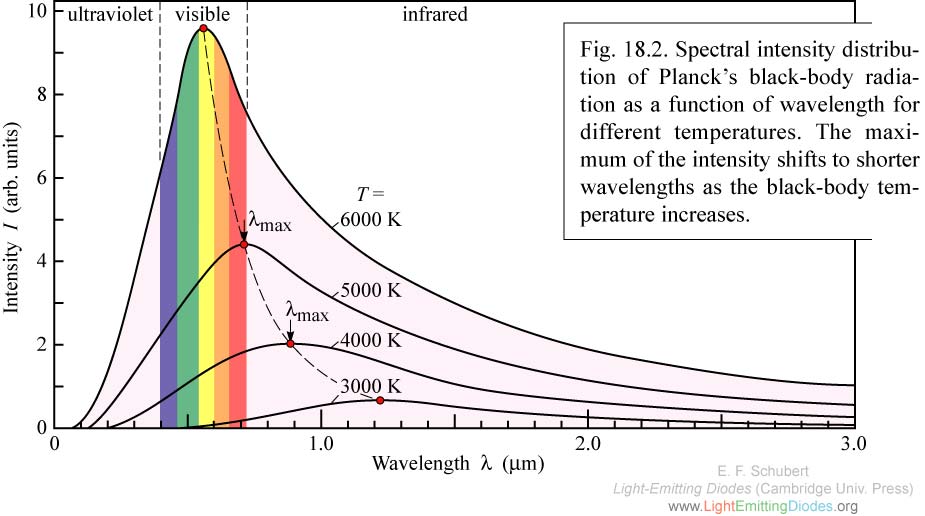
First off, why do objects give off some wavelengths of light but not others? There are two ways an object can have (or lack) color. First, an object can emit light all by itself. You don't do this in the visible range, but the stars do. The graph here shows the light output of several different kinds of stars. You'll notice that each star emits light in all of the visible colors, but in one more than all the others. That's why some stars look blue and others red. Ours looks like the middle curve and actually appears white in space (emitting all of the colors fairly evenly) although it appears yellow on earth (we'll get to that in a bit).

The next way an object can have color is by scattering light that is incident upon it. Depending on the chemical composition of the material, it will absorb some wavelengths and scatter others. Obviously, only the wavelengths that get to your eye are the ones that your brain processes, so you perceive distinct colors in objects illuminated with white light. Scattering is a rather prevalent phenomenon. One of the most common occurrences happens with white sunlight traveling through our atmosphere. It just so happens that the size of air molecules corresponds very well to scattering smaller wavelengths of light. Blue, having the smallest wavelength in visible, is preferentially scattered in every direction, which is the reason we see it when we look at any part of the daytime sky (this is called Rayleigh scattering). If we looked at the source of the light, the sun (note: do not look at the sun), we would expect to see the remaining light; white minus blue, which we call yellow. In other words, if our sky scattered red light, our sun would look green instead. Particles much larger than molecular gas particles (such as water vapor particles) scatter light, but do so evenly. Clouds (composed of water vapor) thus scatter all incident light that they receive evenly, causing us to see white (a phenomenon called Mie scattering).

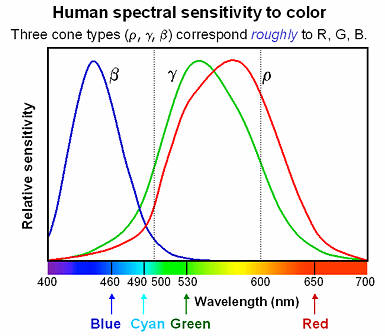
So, when (scattered or emitted) light reaches our eyes, how does our brain distinguish between all the colors? As you are well aware, our eyes have four kinds of small photoreceptors in them called generally rods and cones. Each, by a process known as phototransduction, transmits electrical impulses to the brain when hit with light. However, not all of them respond to the same wavelengths. Some only respond to blue, and others only to green or red. The graph here displays the response functions by wavelength of the three different kind of cones in our eyes. You see that one transduces primarily in the blue range whereas there are two that transduce in almost the same range, but one slightly redder than the other.

Color, then, is just the end product of our eyes' response to a source. Imagine a source at 450nm. The blue receptor responds strongly and green and red each respond to a much lesser degree, but green a little more than red. Thus we see mostly blue with a much smaller dose of red and green. In other words, we see blue on its way to becoming purple. Looking at the response graph, one can deduce that the easiest color to see is at almost exactly 550nm. Here, red and green respond equally in strong measure, producing a sickly-yellow color. It as at this intersection point where the largest number of photoreceptors are giving some kind of response. Interestingly, a human's ability to see this color so well is the reason that they started painting emergency vehicles this color (as pictured here).

All of the colors that we see are simply combinations of red, green, and blue. Sometimes they are represented in the form <ratio of red, ratio of green, ratio of blue>. The "pure" colors are ones that can be represented by only one wavelength. In other words, if you can produce a color by drawing a single vertical line on the receptor graph above and mix the resulting ratios of red, green, and blue, you are seeing what a "pure" color. Some colors require that at least two wavelengths of light combine to create the response in our eye. Brown is the most common example. Consequently, that's why brown is not part of the rainbow; a rainbow diffracts light and allows you to see white light (a combination of all colors) split up into single wavelength portions. Since brown cannot be created in the human brain without at least two stimuli, it cannot be in the rainbow.

The science behind scattering, absorption, and reflection is much, much deeper. But I hope that this allows at least the first look into the beautiful complexity of optics and biology as an application of physics (of course). The resolution of our eyes is astounding. The difference between blue and red light (the extremes of our vision) is only about 10-7m yet our eyes distinguish the myriad of colors and details that make our world vibrant and beautiful.

Wednesday, May 20, 2009

Nomarski Imaging


As per request, I'm going to cover an application of physics today that is really on the proverbial cutting edge. Differential Interference Contrast (DIC) microscopy or Nomarski imaging is an exciting optical method that allows us to "see" microscopic, translucent biological material. As is becoming a theme, I'll need to explain a few concepts in optics before continuing to the meat of DIC imaging.

Prerequisite Light Discussion:

It's no secret that light is a rather complicated beast. First of all, a photon (basic unit) of light is simply a packet of electromagnetic radiation. Sometimes it acts like a wave (it refracts, diffracts, and reflects) and sometimes it acts like a particle (we can shoot photons one at a time, which is no more wave-like than a single water molecule by itself on the beach). To be clear, light is neither a wave nor a particle, but it acts like one or the other depending on the conditions under which we observe it. The wave part of the wave-like side of light is the behavior of the electromagnetic field of which it is composed. The electric field grows stronger and weaker with regular oscillations as does the magnetic field (oriented perpendicularly to the electric field). It is from these oscillations that we determine frequency, wavelength and other wave-like characteristics.

Polarization is the term we use to describe how all of the photons' electric and magnetic fields from a specific source are aligned. If the field oscillations in each photon have random orientations, the light is unpolarized. If all of the electric fields of each individual photon are oriented up and down, we call this vertical polarization. We can also achieve circular polarization by causing the electric fields of each photon to rotate either clockwise or counterclockwise such that at any instant, each of the photons are oriented in the same direction. This is more applicable than you might think. We use polarized filters in sunglasses to cut out reflective glare, in films to produce three dimensional effects (if you wear those silly glasses) and in astronomy (of course).


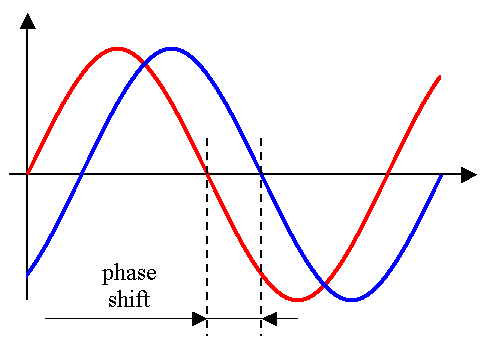
Phase is another important concept in light that we'll need to consider here. As shown in the image, two waves can be identical in amplitude, wavelength, and frequency, but can still be out of phase. This means that their moments of maximum field strength happen at different times. Phase is the reason that photographs don't look the same as real life. A picture can record the differences in intensity of light hitting the screen, but (except for in holography) film cannot record the phase difference in light adequately enough to reproduce it for the observer. The image comes out flat-looking.

DIC Imaging:

Differential interference contrast imaging uses a combination of applications in polarization and phase to image translucent images. 45-degree polarized light is split into two beams, one of 90-degree polarized light and the other of 0-degree polarized light. Though polarization is divided in this split, phase is kept constant. That means that two photons -- one 90- and the other 0-degree polarized -- that passed through the beam splitter at the same time will keep the same relative phases that they had when the beam was together. Each beam is indepentantly but simultaneously passed through the the material using a converging lens. The material is not necessarily homogenous throughout. It will have regions of high density and perhaps regions of differing composition. Since light travels a little bit slower in dense media (with a higher index of refraction), the photons passing through denser parts of the material will take a longer time to get through it. Thus, the phase of each beam becomes variable over the beam, not constant as it was at the beginning.

The beams (each now identically phase-shifted and perpendicularly polarized) are brought back together and projected onto a film. Here, you'll notice that both phase and polarization are recorded in each beam. As the beams combine, not only will they interfere (due to phase differences), causing the texture of the material to become visible through a series of brighter and darker contours, but the three-dimensionality of the material (its thickness, for example) will come out because of the polarization. To see in three dimensions, we must have two slightly different views of the same thing (such as through your left and right eyes). Polarization provides just that sort of perspective, rendering the image in three dimensions. This splitting and recombination of beams to measure objects is known as interferometry and is prevalent in optical and astronomical research, having many applications.

Thus, even though we cannot actually see the material that we are analyzing, its variable density lends itself to visible analysis by exploitation of the propensity of light to slow down in denser media. The images we get yield the kind of extreme detail required to learn about microscopic, organic materials.