Monday, December 6, 2010

Dark Matter

Contrary to what you might think, astronomers are not interested in how much a telescope can magnify an object. In most cases, the objects we are viewing are so far away that we wouldn't be able to see them even if we magnified them thousands of times. The strength of a telescope is how much light it can collect in a given amount of time. The governing factor for this characteristic is the diameter of the mirror used in the telescope. The Keck telescopes in Hawaii have 10m mirrors which enable them to see objects in the sky that are literally thousands or even tens of thousands of times dimmer than you can see with the naked eye. If it is giving off even the slightest bit of light, Keck can see it.

But there's a problem with the Keck observatory, and with all the other telescopes in the world (and those floating above it). To understand it, first we need to imagine a few everyday occurrences.

First, imagine that you are stirring a glass of ice water with a straw. As you spin it faster and faster, a whirlpool begins to form in the middle of the glass. In the very center, the ice cubes are spinning around very quickly while on the outside, they spin much slower. This is a phenomenon known as differential rotation: the further from from the center, the smaller the rotational speed.

Second, imagine a record on a turntable (if you can even remember what they looked like). Let's say that it's a record you aren't particularly fond of, so you don't mind putting a few thumbtacks into it. You put one directly in the center, one halfway between the center and the edge, and one on the very edge of the record. When the record turns, which thumbtack is moving the fastest? Since the every point on the record is connected (i.e. it's solid), every single point makes one revolution in the same amount of time. The thumbtack on the edge has to travel the furthest (it has the largest circle to go around), but it has the same amount of time to do it as the other thumbtacks with smaller distances to go. Thus, the further out from the center of rotation, the faster the object is moving.

Lastly, imagine the Milky Way galaxy. You are probably imagining a big, spinning, spiral cloud of stars like this one here (though this is the Andromeda galaxy, ours probably looks very similar). How do you think it spins: like a record or like a glass of water with ice?

The answer, confusingly enough, is neither. At first, we thought that the galaxy would exhibit differential rotation. But the further out to the edge of the galaxy we observed, the more surprised we became to find that most stars are moving at the same speed. This means that no star orbits the center of the galaxy in the same amount of time (much like ice in a glass of water), but each has the same velocity (which is like nothing we've ever seen before).

So... why?

The frustrating answer is that we have absolutely no idea. The simplest explanation would be to say that the galaxy is much more massive than we originally thought. If the outer edges of the galaxy were permeated with an extremely large amount of mass, the physics works out to predict the so-called flat rotation curve. But therein lies another problem. We can't see anything out there. The Keck sees nothing, Hubble sees nothing. All we see is the stars with nothing (or next to nothing) in between. The stars we see make up only 20% of the mass that our calculations tell us need to be there! The billions of stars out there in our own galaxy, each weighing in at a trillion billion billion kilograms, make up only one-fifth of the total mass of the Milky Way. The rest is stuff we can only call Dark Matter.

Frankly, we don't have the slightest idea what it is. One theory talks about MACHOs (massive compact halo objects) and another, perhaps inevitably, about WIMPs (weakly-interacting massive particles). But all our speculation is just that. It's an almost frightening thought that 80% of everything that's out there has never been seen even by the most powerful telescopes in the world. We know so very little about the universe, about its composition and its behavior. The only thing we seem to really know for sure is that we're missing out on most of it.

Thursday, May 20, 2010

Relativity

We've already discussed how units of time differ in importance depending on who is observing what and when they're observing it. However, more than relative perception, time is, in very fact, relative to the observer. That is, the speed at which a clock ticks depends on who is watching it. The overarching theory being described is called special relativity and was introduced in 1905 by Albert Einstein (while he was working as a patent clerk, no less).

Imagine that you invent a machine that, when sitting on a pitcher's mound, could throw a baseball at exactly 100mph every time. If you put that machine on top of a car traveling at 60mph and then shot a baseball, the ball would be moving at 160mph as a police officer would calculate from a parked car on the side of the road. However, to the person in the car, the ball still looks like it is traveling at 100mph away from him. In other words, the velocity of the baseball depends on who is watching it move. Specifically, it depends on how fast the observer is moving.

We call this principle Galilean Relativity since it was first described by Galileo. There was something that Galileo missed, however, which has to do with the speed of light. It's not his fault, really. He tried to measure the speed of light by sending an assistant to a nearby hilltop. The idea was that he would uncover a lamp and that his assistant would uncover his own lamp when he saw the light from Galileo's. The distance between the two scientists divided by the time between the unveiling of the two lamps would yield the speed of light. However, since light can circumnavigate the earth seven times in a second, he was grossly outmatched. Galileo's conclusion was that light goes really really fast ("if not instantaneous, it is extraordinarily rapid"). Little did he know the fire he was playing with.

Special relativity is founded on the principle that light travels at 3.00×10⁸ ms (we'll call it c from now on) for all observers. Unlike the baseball, if you are in a spaceship traveling at half that speed (c2) and you shoot a beam of light at a "stationary ship", the ship would see the beam of light approaching at c (not at c + c2 as you might expect).

That may seem like an inconsequential—albeit strange—fact, but it ends up being extremely important. That means for someone traveling at 99% of the speed of light who shoots a beam at a "stationary" observer, both the moving and the stationary observer perceive the beam of light traveling at c. If you think about that fact in such an extreme case, some discrepancies seem to arise.

Consider the perspective of the moving ship. If the beam of light is really moving away from it at c, it will pass the stationary observer at some time in the future (we'll call that time t1). In that amount of time, the beam of light will be some distance away from the moving ship (which we'll call x1). Since light travels very quickly, you can imagine that the distance between the moving ship and the light beam at t1 is pretty big (even if it only took a second, the light would be 186,000 miles away).

Now consider the perspective of the stationary observer. He sees the light traveling toward him at c and the ship traveling toward him at 99% of that speed. From his perspective, because the two velocities are so close, the distance between the moving ship and the light beam (in his perspective, x2) will appear to be significantly less than x1.

In the car/baseball example, this is like saying that when the machine shoots the ball, the person in the car sees it moving away from him at 100mph while he is traveling 60mph, but the police officer also thinks the baseball is traveling at 100mph (not 160mph). In his perspective the ball is only moving 40mph faster than the car. So when it hits the police car, the baseball has spent the same amount of time traveling away from the moving car at 100mph in one perspective as it has traveling away from the car at 40mph in the other perspective. The two distances, x1 and x2, aren't the same!

That sounds ridiculous for a car and a baseball, but that's exactly what happens with light. The problem is that only one thing happens. That is, the light beam only hits the stationary ship one time, and the moving ship would only pass the stationary ship once. But if the distance between the beam and the moving ship is different, it seems like the moving ship would pass the stationary ship twice (once in one perspective then later in the other). Obviously that's impossible. At the end of the day, the ship and the light can only pass the stationary observer once. So when does it happen, and where?

This is the problem that relativity solves. When talking about relativity to my students in their introductory physics lab, I discovered that they couldn't answer a simple yet important question: In relativity, what is relative? For instance, in Galilean relativity, we could say something like, "Relative to the police car, the baseball is traveling 160mph; velocity is relative." So, in special relativity, what is relative?

The answer is the genius of Einstein's theory and is two-fold. It's pretty clear that distance, or space, is relative since each ship perceives the separation between the moving ship and the beam of light to be different. If that's true, then for the light to pass the stationary ship exactly once without repeating itself, then each ship must perceive the passage of time differently. That is, for the stationary ship, the distance between the moving ship and the beam of light is small, so the light and the ship pass him in some small amount of time (for the sake of argument, let's say that the clock on the observer's ship ticks away one second between the time that the beam of light hits him and the time that the ship passes him). But in the perspective of the moving ship, the distance between itself and the beam is much larger, which means that it will take much longer than a second to get to the observer once the beam of light hits him.

Remember that two different things cannot happen. If the stationary observer saw exactly one second tick away on his clock, the moving observer absolutely must see only and exactly one second tick on the same clock. The only way that's possible is if the clock ticks slower for the moving observer so that the pendulum swings only once in what must be for him an amount of time greater than one second. In other words, time is relative also.

And that's the answer to the question I posed earlier. In special relativity, what is relative? Time and space. Depending on how fast you are moving and what you are looking at, the distance between two fixed places and the time it takes to get there at a constant velocity is different. For the moving ship in our example, he sees the stationary clock tick away only one second, but he would see an identical clock on his moving ship tick away several seconds. For either observer, the distance between the beam and the ship that we've called the "moving" ship (that's relative, too) is different.

We are so accustomed to thinking that space is constant. If I drive 10 miles to work today, then when I go back home by the same route, I will travel 10 miles. A second is a second is a second, right? Well, not exactly. Time and space are as changeable and as capricious as the velocity of the baseball. It's 160mph to the stationary police officer, 100 mph to the guy in the car, and an infinite number of other velocities to the various people on the road traveling at different speeds.

The thing that is constant is something called "spacetime", a combination (as the name suggests) of "space" and "time", which were considered to be separate, into one single continuum. We have used spacetime to better understand the universe since it, for the first time, explains the behavior of gravity and light with relative (ha!) clarity.

Sunday, May 16, 2010

Time

Time is a concept that's difficult to think about. We divide it into manageable pieces like seconds, minutes, and years, but those divisions are man made. Time itself, as an entity, really has no divisions; it's smooth (as opposed to the percussive passing of ticking seconds in a watch) and unending. Something that time isn't, however, is constant. For understandable reasons, most people assume that a second is a second is a second and that it will never change. Time seems to be the one thing we can count on to always be the same. But it's not true.

First of all, our perception of time, as well as the importance of a given unit of time, varies depending on the system being considered. To humans, a year is significant enough that we keep track of how many of them we've experienced. Years indicate our expected development and position. Yet, babies' ages are frequently counted in months. Their development is acute enough that simply saying "She's about a year old" isn't specific enough. Six months is not the same as nine for a baby, but no one takes note of the difference between a person who is 57 years and 6 months old and their "different" age three months later.

Even then, humans assign significance to different units of time depending on their circumstances. Seconds of age mean nothing, but seconds of a race make the difference between the winner and the loser. We count months of pregnancy, semesters remaining before graduation, decades of fashion and trends (the 60s, the 70s, etc.), hours of sleep, minutes to get ready, and years of experience. Each accepts a unit of time that makes sense.

Physics works in very much the same way. In particle physics, a second may as well be an eternity for particles which exist for millionths or billionths of seconds before decaying. Waiting for a second is allowing for so much change in a sub-atomic system that it would be like examining a 90-year-old man and trying to determine how heavy and tall he was at his birth.

When the universe was a "baby", smaller units of time had significantly more meaning than they do today. We recognize five major milestones in the development of matter before the first second of the universe transpired. In the same way that a month differs in the consideration of the life of an infant, billionths of seconds mattered in the beginning of the universe because even a billionth of a second could double its life. And yet today, not even a second means anything to the universe as a whole. For that matter, days, years, and even millennia are inconsequential moments in the universal perspective. In 100,000 years, 99.9% of all of the stars in the universe will be as identical as a man turning 57 is to himself a day after his birthday (even though they burn hundreds of billions of tons of hydrogen each second). Only when we start talking in millions (and in most cases, billions) of years do we begin to notice the first inklings of significant change.

So, certain lengths of time are only important if they correspond to the length of time it takes for something to change. Even then, in a single system (like that of the universe, as explained above), the important unit of time changes with the passage of time. It depends on who is measuring, when he's measuring, and why he's measuring.

And even then, there's more to the story. Perception and importance aside, a single unit of time differs depending on the observer. With absolutely no metaphor or figure of speech employed, the length of a second (or any other unit of time) depends upon the velocity of the person observing the thing experiencing the second. The principles behind this fact are all contained in Einstein's explanation of time and space which is known generally as (trumpet fanfare) relativity and will be discussed in the next installment.

Thursday, April 22, 2010

Circumstellar Masers


The image above is called the Hertzsprung-Russell (H-R) Diagram. In a very simple synopsis, it relates the temperature (and thus, the color) of stars with the amount of light they put out. As you can see, the higher the temperature (and the bluer the color), the greater their total luminosity (energy output per unit time). The long, slightly bent line in the center is called the "main sequence" and is where we find stars in the middle of their life.

If you look at the top corner, though, you'll see two clusters: one a straight line labeled "supergiant" and the other a hockey-stick-shaped line labeled "giants." Both of these branches of the H-R diagram have to do with the death of stars. Everyone is generally familiar with super nova star deaths, where a star explodes in a violent output of energy and is no more. However, most are unfamiliar with the less extravagant, more common method of star death.

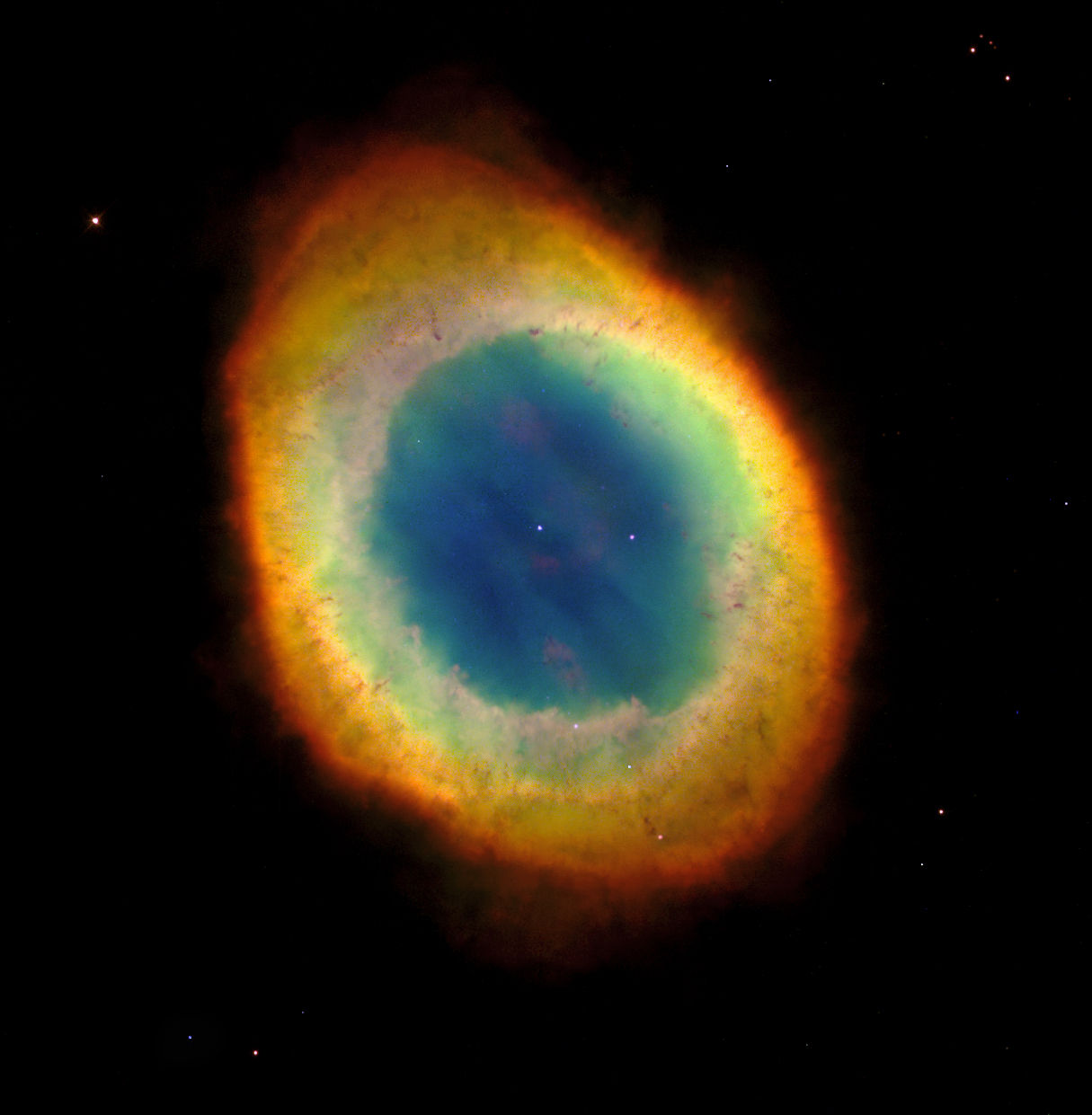
Small stars (all stars with a total mass less than about 8 times the mass of our sun) are too small to explode. Instead they swell up. At the end of their life, all of the hydrogen they were so used to fusing into helium is depleted. With no radiation pressure to keep it at the size it was, the star contracts due to its immense gravity, which crushes the helium at the center. Suddenly, the density becomes so great that the helium core starts to fuse the helium into carbon. An enormous amount of energy is released, pushing the edge of the star to an unprecedented radius. In fact, when our sun starts to swell into a red giant, its radius will extend until its surface is at about where the earth is now (about 93 million miles)! The so-called giant branch on the H-R diagram shows us that as stars leave the main sequence in this manner, their luminosity increases by several orders of magnitude (as a result of the brightly burning helium). The star gets so big that its outer layers star to peel off and expand into space, leaving a very hot chuck of carbon ash in the middle (called a white dwarf star) and forming what we call a planetary nebula (an example of which you can see here).

Some stars, however, don't quite make it to that stage without a fight. They get so big that the helium fusion at the center shuts down. As before, with no outward radiation pressure, the star contracts and crushes the helium core until it starts fusing again. This cycle repeats and repeats in a process known simply as "variability." The star increases in luminosity and decreases again in a matter of days or years (depending on the star) but with such regularity that we can spot them a mile away (ok, more).

Even then, a few layers of gas on the very outer edge of the star manage to escape and expand in a sphere around the star. As you would expect, heavier molecules expand slower and lighter ones move faster; we soon see a separation of individual gases. The fascinating thing about these expanding envelopes is that they quite naturally form lasers.

All of the lasers on earth are man-made. A study of the Einstein coefficients and some fancy math told us that they were possible and we gave it a shot. Eventually we created the right conditions to make a concentrated beam of stimulated emission. Looking into space, however, we can see gigantic (some can be almost 5 billion miles wide!) stellar lasers (which we call masers because the photons coming from them are microwaves) which are continually fueled by the variable star in the center.

These huge masers emit in all directions, which means that when we look at variable stars, we commonly see maser emissions (if we're looking for the right wavelength with our telescope). In other words, all over space there are absolutely enormous laser pointers shining directly at the earth. Just another proof that the universe is way cooler and more complicated than you thought before.

Saturday, April 3, 2010

The Foucault Pendulum


Have you ever seen one of those pendulums that swings back and forth but over the course of a day or so makes a complete circle? It's called a Foucault Pendulum (and please, people, it's pronounced /Foo-coh/ not /Fow-cult/). I'm going to tell you how it works.

Get some thread and tie a relatively heavy object (a ring, for example) to one end to make a pendulum. Suspend it from your car's rear-view mirror on the windshield. Before you make a 90° turn, start the pendulum swinging so that it swings directly toward and away from the windshield. Execute 90° turn. The pendulum is now swinging side to side towards the passenger- and driver-side windows. BAM. Foucault pendulum.

No, seriously. This is exactly the same idea, but the thing that's turning is the earth. If you get a really heavy pendulum and have it swing with no friction, it's rotational inertial is very high (i.e. it is very hard to get it to start travelling in a circle). So when the earth rotates, it tends to swing in the same absolute plane as when it started. In the car example, if the windshield-rear-window plane is North-South, then when your car turns, the pendulum is still swinging N-S but the plane of oscillation relative to the car has rotated 90°. The car has, in effect, turned around, above, and underneath the pendulum which is still swinging in its original plane.

Interestingly enough, the time it takes for a Foucault pendulum to complete a full revolution in the relative frame (i.e. when it looks like it's swinging the way it started out to observers on earth), varies depending on latitude because of the Coriolis "force" (just a side note here. Please never ever refer to the Coriolis "force" as the thing that makes toilets flush in the opposite direction south of the equator. Hearing that drives me crazy). Simply stated, if you stand on the north (or south) pole, you turn in a full circle once a day (just like everywhere else), but your linear velocity is zero (you just spin around in a circle because you're standing on the axis of rotation). Standing on the equator, you still make one full revolution per day, but now you're 6000 km away from the axis of rotation (thus, your linear velocity is huge. Think of how the middle of a spinning record and the edge of a spinning record both go around at the same frequency. For this to happen, the outside point must be moving much faster than the inside point. Same idea as a marching gate turn (for parades); the inside guy just rotates in place, but the outside guy tears a hole in his pants taking long strides to keep the line straight).

In other words, there is a velocity gradient between the poles and the equator, meaning that as you get closer to the poles, your linear velocity decreases. We don't notice it because frictional forces (our feet on the ground) keep us in the same relative position. A free-swinging pendulum, however, swings above an earth with faster linear velocity at (minutely) lower latitudes and into slower linear velocity at higher latitudes. The earth is travelling faster under the pendulum when it is further to the north. So, think of how a tank turns. If both treads move at the same speed, it goes straight, but if one tread moves faster than the other, it turns. So with the pendulum, when the earth under the pendulum at its northern-most swinging point moves slower than the earth under the pendulum's southern-most point, it appears to turn in place (but we know it's really the earth doing the turning). Now on the equator, the pendulum feels a Coriolis "force" when it swings north, but then the exact opposite "force" when it swings south, so it stays in the same plane. At my latitude (40° N), the pendulum takes a little more than 37 hours to make a full revolution relative to an observer. At the north pole, it takes exactly 24 hours.

So how do they make a pendulum swing without friction? Well, they don't. However, they can counteract the force of friction using a (patented Newton's first law) equal and opposite force (Ok, I know that using the words equal and opposite sounds like the third law, but the law that's really in effect here is that if the net force on something is zero, it doesn't accelerate—first law). At the top of our Foucault pendulum at BYU there is a metal disc (Radius ≅ 3 in) that swings into an electromagnet once per oscillation. At the peak of the swing, the magnet turns on momentarily, turning the disc and undoing the frictional force from the swing. So, we can't really make a frictionless pendulum, but we can make it act like one. In any case, the electromagnet doesn't cause any acceleration, it prevents (or counteracts, rather) negative acceleration.

You may be wondering why I keep putting quotes around the word force when it's next to the word Coriolis. I'll tell you. It is not a force. It just looks like one. Imagine if you sat in a room with a flat floor with no windows. The room is actually on a turntable and spins around in circles (but so slowly that you can't feel it). To you it seems like a normal room, but if you set a ball on the perfectly flat floor, it would start to roll towards whichever wall it was closest to. In your Newtonian-trained mind, you would think "Hey, the ball accelerated. There must be a force on it." But you would be wrong because you are now in a non-inertial (accelerating) reference frame where Newtonian physics doesn't apply. The thing that's feeling the force is the frame of reference itself. The ball rolls because the floor is turning (accelerating by changing direction, not speed) underneath it. Hey! That sounds like a Foucault pendulum. Yep. The "rotating room" we are in is the planet earth. It's so big that we don't notice it spinning (except for the sun, moon, and stars) but sometimes we find things that seem to violate physics. They don't. Trust me.

Sunday, January 10, 2010

Kepler's Laws

Astronomy has come a long way in the last several thousand years. We are able to locate celestial bodies with unprecedented precision and the light that we analyze from these sources tells us more information about them then we could have ever expected. However, when considering the most talented astronomers in history, the originals make a fairly convincing argument without even considering the immense effect of their studies on future astronomers. Tycho Brahe made the most accurate measurements in history with extremely rudimentary instruments. More amazingly, his assistant Johannes Kepler used these instruments and stated three laws of planetary motion that still stand. It's important to realize that these laws came not from any mathematical treatment as most do; rather they are a product of extraordinarily accurate measurements and deduction.

Kepler's First Law

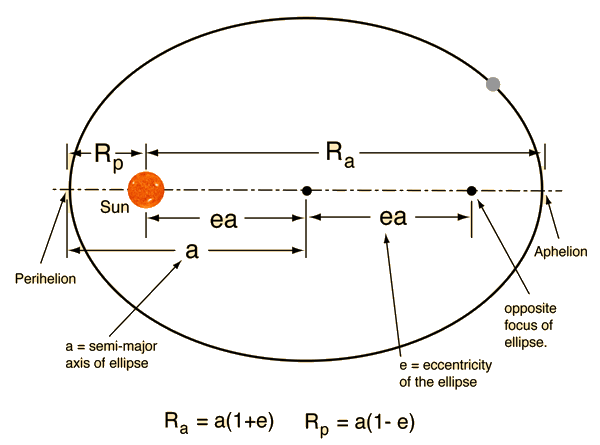
The orbit of every planet is an ellipse with the Sun at a focus

Before Kepler, it was thought that planets traveled around the Sun in a perfect circle. Instead, the Sun resides at one of two foci. The discovery of elliptical orbits helped to explain the motion of and interaction between planets as well as comets and asteroids.

Kepler's Second Law

The line joining a planet and the Sun sweeps out equal areas during equal intervals of time

This law is a little more difficult to understand at first glance. It is generally believed that the Earth travels at the same speed all the time, but this is a misconception. Because the planet orbits the Sun in the shape of an ellipse it is not always the same distance from the Sun. And the closer it is to the Sun, the faster it goes. The picture above depicts two different periods of equal time in the path of a planet. Though the Earth moves farther in a given time when closer to the Sun, the area it sweeps out when a line is drawn between it and the Sun remains constant for that given time. In other words, the two shaded areas are exactly equal. This may seem like a small thing, but it helps us to understand the variable motion of the planet which aids us in calculating what the real time is (which allows us to calculate leap days, leap minutes, leap seconds, etc. which keep Spring on the 21st day of March).

Kepler's Third Law

The square of the orbital period of a planet is directly proportional to the cube of the semi-major axis of its orbit

In simpler terms, the only thing that determines the length of a year of a given planet it its distance from the star it orbits. In other words, if the positions of Jupiter and the Earth were switched, they would also switch years. Jupiter would have a year of 365.25 days and Earth would orbit the Sun every 4,331.6 days.

Again, these laws may seem inconsequential, but they are both influential and incredible when you consider their source. It wasn't until Isaac Newton invented calculus that he was able to prove these laws. They were all stated by Kepler from very accurate observation with what we would consider rudimentary instruments. Further, such accuracy has furthered the science of Astronomy in every way (just because knowing the correct behavior of a system yields further discovery). For example, even after applying all of Kepler's laws to the orbit of Mercury, we were still unable to predict the exact position of the planet; we were off by a few fractions of a degree. This was later accounted for by Einstein and presented as a proof of the variability of time for moving bodies in a paper on relativity. So we see yet another example of a small observation later affecting a hugely important physical discovery.

Tuesday, December 29, 2009

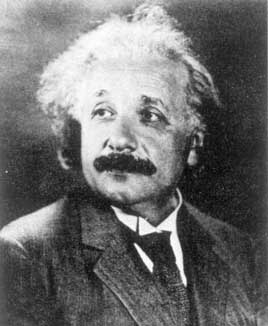
Albert Einstein


b. 14 March 1879
d. 18 April 1955

I will not attempt to explain the contributions that Einstein made to physics in this little biographical sketch. For one thing, I don't understand the majority of what he wrote. For another, I would like to focus instead on his character and life as an interesting and important glimpse into his mind.

Though born in Germany, Einstein did not die a citizen thereof. In fact, he renounced his citizenship for the small price of three German marks and became a naturalized citizen of Switzerland five years later, paying twenty francs. The price of his citizenship notwithstanding, national affiliation was extremely important to him. He both detested and rejected the nationalistic and militaristic government of Germany and embraced the peaceful attitude of Switzerland. To the end of his life, Einstein remained a pacifist, conceding only that military force should be used to combat institutions which "pursue the destruction of life as an end in itself."

He further hated the German educational system which consisted of rote studies and a particular deference to authority. Though it is often stated that Einstein was a poor student, the more accurate statement is that he did not thrive in the stifling classroom being forced into a discipline in which he was not naturally engaged.

In fact, after being rejected from the Zürich Polytechnic Institute, Einstein spent a year in Aarau, Switzerland where he succeeded in a flexible education with a casual teacher who allowed Einstein a liberty of thought that was necessary for his future discoveries. About the necessity of such liberty he wrote that "it is, in fact, nothing short of a miracle that the modern methods of instruction have not yet entirely strangled the holy curiosity of inquiry; for this delicate little plant, aside from stimulation, stands mainly in need of freedom."

His ability to thrive in a self-determined schedule accounts for his eventual success at the Zürich Poly (having been accepted after a second application). He largely ignored his classes, showing up only for the exams which he passed due to the copious notes of his studious friend Marcel Grossmann. After graduation, Einstein found his desired freedom in an unlikely place. He was refused a position as an assistant at the Zürich Poly (perhaps due to some underhanded manipulation by a professor who disliked him) and accepted a job at the Bern Patent Office in 1902 where he was assigned to read and approve patent applications. The job proved useful, however, in that it was not difficult. He spent his spare time theorizing and conducting gedankenexperiemnts (literally: thought experiments) which are designed to prove a principle without actually having to conduct the experiment physically.

Einstein was so successful in this free environment that he published three papers in the 1905 edition of Annalen der Physik each on a different subject. The first, for which he eventually won a Nobel Prize, explained the connection between the photoelectric effect and quantum mechanics. The second paper treated molecular behavior. The third was his inspired explanation of relativity which gave rise to spacetime. To restate for emphasis, during seven years working as a patent clerk, Einstein published—among others—a Nobel Prize winning paper and the foundational paper for the most (culturally) famous development in science.

Inevitably, Einstein was noticed by the scientific community. He subsequently worked in Berlin at the Prussian Ministry of Education with Max Planck (a great scientist in his own right who wrote of him, "All in all, one can say that among the great problems, so abundant in modern physics, there is hardly one to which Einstein has not brought some outstanding contributions.") and at Princeton. But the former was overrun with Nazis and the latter boring yet peaceful enough for him to, as he wrote to the Queen of Belgium with whom he had apparently frequent correspondence, "create for [himself] an atmosphere conducive to study . . . free from distraction."

He was married twice. And though the first marriage failed due probably to a lack of attention to his family in favor of scientific pursuits, he remained supportive of his first wife and children, sending them his prize money after receiving the Nobel Prize in 1921 (two years after his marriage to his second wife, Elsa). Elsa was described as "gentle, warm, motherly, and prototypically bourgeoisie." She enjoyed the fame of her husband's publications and tolerated his absence and distractions.

Notably, Einstein's genius was not happened upon, nor was it easy to obtain. Though none can deny his natural ability in theoretical physics, the secret to his success was work. Though some concepts eventually unfolded before him, others such as his Unified Field Theory never came to fruition. Yet he never ceased his work nor became discouraged. "After all," he wrote, "to despair makes even less sense than to strive for an unattainable goal." Three months before he died, Abraham Pais, one of Einstein's biographers, visited him at home and spoke with him for a half an hour. Einstein had been at his desk working when Pais entered and before Pais was able to leave (a journey of approximately five steps), Einstein was hunched over his desk "oblivious to his surroundings" yet again.

Now, fifty years after his death, Einstein remains one of the most well known names in scientific and even in common history. His developments in theoretical physics, along with those of Planck, de Broglie, Schrödinger and others, laid the groundwork for most if not all of the scientific developments that came thereafter.

Thursday, October 29, 2009

Quantum Tunneling

Classical Mechanics


Quantum tunneling allows us a fascinating glimpse at the workings of the subatomic world. We have learned in the last one hundred years or so that atoms aren't really the miniature solar systems that we all imagine them being—a relatively huge nucleus with tiny electrons swirling around it like planets. In fact, we can't really say much of anything about where electrons are or where they're going. It turns out that all we can really say is where they might be at a given time. Let's back up a little and try to illustrate this principle with an example.


Imagine a roller coaster on a track shaped like the black line pictured to the right. It's pretty easy to imagine that if you started on the left side where the red line intersects the slope that when they drop, the cars would easily roll over the middle hump and up the other side to the red-black intersection point on the right side (in fact, it would go to that point exactly if we neglect air resistance and friction). Even though the roller coaster dips pretty deeply just to the left of the center hump, it's not difficult to imagine that the cars would be going fast enough to get over the hump with speed to spare.


Now imagine that we start on the left side again, but this time at the point where the blue line intersects the track. Dropping from this height, we can see that the cars don't have enough energy to get up over the hump. Starting on the left side means never getting to the right side and vise-versa. We'd need some kind of chain (like the ones that they use in roller coasters to pull you up the first hill) to do enough work on the cars to get them over the hill. In other words, unless the roller coaster cars got energy from somewhere else (like being pushed at the beginning or dragged up the slope with a chain) they will never see the right side of the track.

Everything we just discussed comes from "classical" mechanics, which imagines that everything is solid and exists where it's supposed to exist in the way that it's supposed to exist. Unfortunately classical mechanics breaks down when the system is really small (such as in an atom). We'll talk about one way that it stops working after a little lesson in terminology.

Terminology


The term "potential well" refers—in effect—to the dips in the track. In the case of a roller coaster, the "well" is formed by gravity in that the deeper you go into it, the more energy you need to get out. We can see a more solid example of this in the system of the earth. Imagine that our planet is resting on a large rubber sheet, causing a depression. To get into outer space, we must climb out of the hole first which means that we need to have enough energy to get out without falling back in. Once out, we are free to shut off the engines and simply coast (which is how we got to the moon) because there is no danger of falling back into the earth's potential well.

Potential wells can be made from all sorts of things. For instance, a large chunk of positive charge (such as an atomic nucleus) creates a potential well into which negative charges, like electrons, fall (the reason they don't ever fall into the absolute center is a complex question that we won't get into here). In the same way as with gravity, for an electron to escape a nucleus' potential well, it must have at least enough energy to climb out of the hole.

The other term that we need to understand is the "wave function." We refer more to the wave functions of tiny particles than to where they are or how fast they're moving because it allows us a little more accuracy in measurements. In effect, we say that particles have a tendency to behave like waves under the right conditions. For example, electrons (which have definite mass) have a wavelength and a frequency and can even diffract (bend around obstacles) like water waves do. As a result, when an electron is in a potential well, instead of thinking of it as a ball rolling back and forth between to peaks of maximum energy (like a roller coaster), we think of it as being a wave bouncing back and forth between two walls (think of dropping a pebble in a bowl of water and watching the waves bounce around). The size of the wave function at a certain point represents the probability of the electron being found at that spot. That is, the bigger the wave function, the more likely it is to find an electron there if we choose to measure it.

Quantum Tunneling


Remembering the blue track example, imagine an atomic potential well of that shape. Perhaps there are two nuclei of differing charge (so that one is deeper, or has a greater propensity to pull an electron than does the other) close enough together to affect a single electron. We can imagine that the larger of the two nuclei could, under the right circumstances, trap the electron in the deeper well, making it impossible to overcome the hump and orbit the other, smaller nucleus. Classically, this is exactly how we'd explain it.

However, we have observed that sometimes the electron, after having been trapped in a potential well and without enough energy to get out of it, sometimes escapes. This is evidence that the electron is behaving like a wave. Imagine clapping (thus making a sound wave) in a room with closed doors. Can a person outside the room hear you? If you clap loud enough, the sound wave will hit a wall and make it vibrate a little, causing the air on the other side of the wall to vary in pressure a little. That pressure variance becomes a pressure (sound) wave that can travel to another person's ear. It's not as loud, but it's still the same sound.

So also with an electron, when it's wave function hits against a wall, it sometimes tunnels into it. If there is another potential well on the other side close enough and deep enough, the electron will be transmitted to the other side (though with a much weaker wave function). Unlike with sound, the fact that the wave function has a smaller amplitude does not indicate that the electron is any less of one. In fact, it is the same electron that was on the other side of the well. The fact that it has a smaller wave function only means that it is less likely to be there if we chose to measure it. However, that probability only applies to the exact time of measurement. In all other times, the two nuclei behave as if the electron were always with it (even though measurements may seem to indicate that it is with one particular nucleus 80% of the time).

Maybe this all sounds obscure as if it couldn't possibly matter to a normal person, but what I've just described is a covalent bond which is the kind of bond that keeps two hydrogen atoms attached to an oxygen atom in water molecules (and, consequently, the bond that makes most or all of the molecules in air stay together).

Conclusion


The take-home message of quantum tunneling is that small particles act very differently from large ones. I guess, technically that grapefruits have wavelengths too, but for reasons associated with the Uncertainty Principle, the effect that quantum mechanics has on large objects is negligible. But on very small scales, classical mechanics breaks down. Objects that we imagine to be solid become waves, Newtonian mechanics breaks down, and nothing seems to work the way we expect it. The usefulness of knowing exactly how they act on that scale is important, though, as we can see by examining its effects. Knowledge of quantum tunneling leads us to innovations such as flash memory (which the thumb drive in your pocket uses), semiconductors (a fundamental component in computers) and chemistry.

Wednesday, October 21, 2009

Universe Synthesis: Part III

In the last two installments of the Universe Synthesis series, I explained in relatively simple terms what happened during the first 380,000 years of the life of the universe. In the first trillionth of a second or so, the four major forces that we know today split from the single force that they started out as, and then the first inklings of matter formed. We left off with the creation of hydrogen and helium.

The problem with an expanding universe is that as is expands, it loses kinetic energy. Imagine two pots of boiling water (each with an equal amount of water in them). If you set one on the stove and dump the other one on the floor, which will cool down faster? Clearly, the water, as it expands, radiates (and conducts) more heat away from it at a faster rate. In the same sort of way—as the universe expands—it cools down. Unfortunately, it takes energy to force atoms together to make heavier atoms. At 380,000 years after the Big Bang, the universe is overwhelmingly (if not completely) devoid of any element heavier than helium. With the matter in the universe cooling and spreading out at an alarming rate, how did the rest of the periodic table form? Where do we get carbon, oxygen, nitrogen, iron, and gold?

The answer is—in the simplest form—gravity. The fast expanding space is filled, intermittently with enormous clouds of hydrogen (mixed with a very little helium). But the clouds aren't homogeneous; they're clumpy. In some places there are a few more atoms per cubic centimeter, making the region very slightly more massive than the areas around it. Believe it or not, this is the beginning of a star.

The slightly-more-massive clump has just a little stronger gravity than the other slightly less dense regions. As a result, other hydrogen atoms are statistically more likely to fall into the clump and join it. Over a very long time, the clump gets larger and larger, becoming more dense and more compact. As it gains matter (again, only hydrogen), the matter tends to fall towards the center of gravity, causing a particularly large mass of hydrogen gas to start forming there. The gas pushes on itself, or rather, it pulls it self together by its own gravity until the pressure is so great that it ignites.

Ignition, here, does not have the same meaning as it does on earth. The hydrogen is not burning, per se, it's fusing. The pressure is so great that the atoms are fused together. Two protons (which is just a hydrogen atom without its electrons) are fused into deuterium (still hydrogen, but with an extra neutron), deuterium and another proton make helium. Helium fuses into lithium, which fuses into beryllium. This is called the proton-proton chain. In heavier stars, there's enough thermal energy to initiate the CNO cycle, which creates primarily carbon, nitrogen, and oxygen. With each fusion reaction, a little bit of energy is released as light. The light you see when you look at the sun (note: don't look at the sun) is the byproduct of the proton-proton chain.

Atoms continue to fall toward the center of gravity. As they do, and because they do not fall uniformly in every direction, the whole mass begins to spin. As it does, a disc that is perpendicular to the axis of rotation begins to form around the newly formed star. Matter begins to collect into the disc. Soon a star is happily burning. Around it, other pockets of dense hydrogen have started to burn. The whole collection of them is now a galaxy.

In course of time, the star runs out of material to burn. Heavy stars can get big and hot enough to force helium, carbon, and other heavier elements to burn, but eventually the matter in the star ceases to fuse. Either gently, bit by bit, or in a violent explosion, the layers of new elements are ejected into the interstellar medium (left-over hydrogen), enriching the surrounding area with new elements. In the particularly large explosions, the atoms gain enough energy to fuse into extremely heavy elements such as gold, copper, tungsten, or mercury. Since the interstellar medium is still, even after all that, predominantly hydrogen, the whole process stars again. Only this time, the conglomerating gas is enriched.

When the disc forms around this new star, the heavier elements stay behind as the hydrogen and helium fall towards the center. Close to the star, almost all of the hydrogen falls into the giant fusion reactor leaving behind rocky clumps of carbon. These clumps eventually collide and conglomerate themselves, forming huge spinning rocks that eventually form terrestrial planets. Further out, lots of hydrogen and helium remains to collect into large, dense clouds not big enough to become stars; they become gas giants. The further away a gas giant is from the star, the more molecules are able to form in its atmosphere (being cool enough to form them without immediately breaking them apart again) such as methane (which is what give Neptune and Uranus that nice, blue color).

Lest you think that we'll one day run out of building materials, consider that after 14 billion years of element synthesis, the detectable matter in the universe is still 75% hydrogen and a little less than 25% helium. That is, everything else that is not those two elements comprises much less than 1% of the total matter in the universe. Even then, consider your car, your kitchen appliances, a gold deposit in a mountain, or the circuitry in your computer. A long time ago, in a galaxy far away (I couldn't resist, but seriously...) every single one of those atoms was being shoved together in the first few seconds after a violent supernova explosion. And every single breath of air you take is filled with atoms that were fused inside a star millions of years ago. We live and breathe stardust.
__________

So, that's how it happened. Or, at least, that's the best we can do at explaining it right now. This model is constantly being reformed and reworked, and new processed are constantly being discovered. One of the most amazing things to me is that almost all of this information was deduced by astronomers looking at the sun and other stars (note: do not look at the sun unless you are a trained professional). The only information from those sources that we can get is the light that they give off. In other words, astronomers found a way to deduce all of this just by looking at patterns of light given off by stars and combining it with what we already know about physics on earth. That, to me, is an amazing accomplishment.

Thursday, October 1, 2009

Heisenberg Uncertainty Principle

Imagine that you take a picture of a moving car. Depending on the kind of camera you have, your pictures will develop in one of two ways. First, it is possible that your camera has a really slow shutter and that the car is blurry. If you knew the shutter speed of your camera, you could make a pretty good guess at how fast the car was going by studying the size of the blur. Even then, however you wouldn't be exact. The only problem would be to describe exactly where the car was at the moment you took the shot. In fact, you couldn't say that it was anywhere precisely at the time you took the picture. All you could do with any degree of certainty is decide that the car was between two definite points (the beginning and end of the blur) during the entire second that you took the picture.

The other kind of shot would have been taken with a camera that had a very, very fast shutter speed. The picture would turn out crisp, with almost no blurs at all. Finally, we know exactly where the car was at the instant the picture was taken. Unfortunately, by gaining this information, we've lost information that we could have known. Now, looking at the picture, we have no way of saying how fast the car was moving. For all we know, it could be standing still.

In either case, the picture cannot ever tell us everything we want to know about the car. We get one side or the other. And it has nothing to do at all with the quality of the camera. Even if we were using the best camera in the world, a slow shutter would tell us lots about velocity and a fast shutter would give us a good idea of position. This conundrum is the basic idea of the Heisenberg Uncertainty Principle.

Before the advent of quantum physics, it was believed that if we knew the exact position and velocity of a particle then we could determine exactly where it would be at any point in the future. I suppose we could still think of that as being true. The problem is trying to measure both of those quantities simultaneously. We encounter the same problems as we did with the camera. We can only simultaneously determine momentum and position to a certain degree of accuracy.

It's important to realize that the illustration that I gave above with the car is only a metaphor to help us describe the real Uncertainty Principle. In actuality, that "certain degree of accuracy" is an extremely small number (≈10-34) and is thus only really an issue when we are talking about very small things like electrons.

The issue is not, however, as trivial as the particles are small. What are the implications of the Uncertainty Principle? First, we learn that it is impossible, regardless of the quality of the instrument, to learn everything about everything. The information provided to us on the sub-atomic scale is finitely limited. But, that's not necessarily a bad thing. Sometimes it is useful to know in precise terms that which we do not know. Such limits imposed on us by the universe have helped us to understand the shape, size, and configuration of an atom, and thus to describe more completely atomic interactions.

Further, the very idea that we cannot be exactly precise in our measurements caused a paradigm shift that defines the way we think about science today. Before this principle (and others such as de Broglie's wave mechanics and wave-particle duality), people were generally under the impression that the universe was deterministic—that every future event could theoretically be predicted. Now, we view the universe as being probabilistic instead—that we can only know the probability of a future event to happen. The probabilistic ideology, though seemingly less "correct" was something of a step away from perfect—though ultimately incorrect—answers and a step toward the best philosophy of understanding at which we can arrive.

Sunday, August 23, 2009

Lasers

Introduction


The first laser was built by Theodore Maiman and is recorded as having been first displayed on 16 May 1960. This invention is particular, in my opinion, because it is not a naturally occurring phenomenon in the visible spectrum. Unlike lots of other inventions which come simply from us harnessing phenomena that we have discovered, lasing is a step ahead of what nature gives us, a complex application of several principles together to create something new.

Explanation


Laser is really an acronym—Light Amplification by Stimulated Emission of Radiation—which was first postulated by Einstein in 1917. As the name suggests, a laser is really the combination of two separate optical phenomena, stimulated emission and light amplification, which we will explain here.

Stimulated Emission


Emission, as its name connotes, is the term we use for a photon which is created by an atom. To understand this phenomenon, we need to understand atoms a little bit more.

When you picture an atom in your head, you probably imagine a small solar system sort of design with a nucleus of protons and neutrons in the middle and little electrons spinning around it in circles. Sadly, this is not the case, but the model serves well to illustrate emission; so we'll use it with the understanding that it is really not particularly accurate. Electrons in every atom under normal conditions orbit the nucleus in the closest possible orbit (which, for quantum mechanical reasons, is not physically touching the nucleus). Certain molecules (H2 gas, for example) undergo excitation when they are hit by photons of sufficient energy which means that the electron is temporarily pushed to an orbit further away from the center. However, as things in physics tend towards the lowest and most stable energy state, the electron jumps back down to the ground state. The effect can be imagined as being like marbles in a funnel. The faster you push the marbles, the higher they rise in the funnel as they spin around. But over time, no matter how hard you first pushed them (assuming that they can't leave the funnel) gravity will pull them back to the lowest available spot. And since energy can't just disappear, the energy that the electron lost by jumping back down to a lower orbital is emitted as a photon of light of that exact amount of energy (we'll call this precise value ΔE). This is emission.

Stimulated emission is somewhat more complicated. An excited electron in a higher orbital will, obviously, spend some amount of time (it's really short) in the excited state before jumping back to ground state. If a photon whose energy is exactly ΔE passes very very close by the excited electron, the electron will jump before it normally would. Thus the emission was artificially stimulated.

Light Amplification


Light amplification is a direct result of stimulated emission under correct circumstances. If there is an excited medium (maybe an energetic cloud of H2 gas), we can imagine that eventually one of the excited atoms will revert to ground state and emit a photon with energy ΔE. That photon will almost definitely pass near enough to another excited atom (if the cloud is big and dense enough) and stimulate the emission of another photon. Luckily for us, when a photon is emitted by stimulation, it is released in phase with and in the same direction as the incident photon. In other words, where there was one photon, now there are two traveling in exactly the same direction at the same time and in basically the same space. The light is now twice as bright. But these two photons will eventually collide with other excited electrons and stimulate more emission in the same direction. A chain reaction causes a short, bright burst of energy as all of the excited electrons in the direction of stimulation are forced to revert to ground state.

Lasing


The problem with the described situation above is that the cloud of gas runs out of excited electrons extremely quickly. To produce a laser, we need a continuous stream of stimulated photons. To produce this effect, we continually excite the gain medium by a very energetic source of light (a flash lamp or another laser) so that every time an electron jumps to ground state, it is quickly re-excited. Then we put the gain medium between two mirrors that face each other. Eventually, stimulated emission happens in the direction of the mirrors and an amplified light source bounces back and forth between the gain medium, becoming even more amplified. If the optical pump is strong enough, the cloud will never run out of electrons to stimulate. The amplification cycle is infinite (not that it increases in brightness forever, only that it will forever produce a continuous beam of light of a certain brightness that is unidirectional and in phase). To release the beam from the mirrors, we make a part of one of the mirrors semi-translucent so that some of the photons escape when the beam hits that mirror. The escaping photons come out in a beam which we call a laser.


Applications


We use lasers more than you might think. The ubiquitous laser pointer is, of course, one use. However, lasers now assist in medical surgeries, read CDs, cut and weld metals, and are used in printers (you know, laser printers) among many other things. They have become widely used and are on the forefront of our active scientific pursuits today.

Wednesday, August 5, 2009

Photoelectric Effect

Einstein won the Nobel Prize in Physics in 1921. Lots of people assume that he won it either for his work in relativity or for the immensely influential equation E=mc2. However, it was for his groundbreaking discoveries in a physical phenomenon known as the photoelectric effect for which he was awarded the Prize. Herein we will discuss the phenomenon and its subsequent applications and implications.

Explanation:

Simply, the photoelectric effect is the emission of electrons from a metal as a result of incident light. In other words, sometimes, when you shine light on a piece of metal, some of the electrons in the metal come unbound and fly freely though space. I guess we need to back up and talk a little about metals.

One of the properties of metals is the configuration of its electrons. When a whole lot of iron atoms (to use one of many metals in the periodic table) get together, they start to share their electrons. However, unlike other solids, metals share their electrons with the entire solid. The top layer of electrons are free to flow anywhere about the surface of the metal, bound to no specific atom. Incidentally, this property is what makes metals such good conductors of electricity; the "fluid" electrons on the surface carry and transport charge very efficiently in much the same way as it is easier to slide over a wet surface than a dry one.

This property of metals is what makes the photoelectric effect possible. When you shine light on metal, the sea of electrons (as it is often called) receives lots of energy, causing some of the electrons to shoot off. However, not just any kind of light can make it happen. Imagine a swimming pool that is only filled up half way with water. If you were to throw a rock into the pool, you could make some of the water splash out, but only if the rock was traveling fast enough. Even a whole bunch of rocks traveling too slow would only make lots of splashes that didn't remove any of the water. In the same way, light needs to be energetic enough to cause the electrons to escape from the sea. The minimum energy that is required for a photon to remove an electron from a metal is called the work function (symbolized by the Greek letter φ).

Implications:

The implications of this discovery were shattering to the world of physics. There was a huge debate at the time concerning the nature of light--whether it was a particle or a wave. Einstein's discovery helped us to understand the truth. As I mentioned before, only light with a certain minimum energy (equal to φ) could make electrons leave the metal. Einstein discovered that this minimum energy could only be achieved by changing the color of light, not the intensity. That means that red light, no matter how bright, will never induce the photoelectric effect, whereas very very weak ultraviolet light will always do so. We learned some great truths through this. First, the frequency of light (its color) is directly related to its energy. In fact, frequency is the only factor that determines photon energy. Intensity (brightness) of light corresponds not to energy, but to the number of photons hitting the area per unit time.In other words, shining really bright, red light on the metal was like throwing lots and lots of rocks really slowly into the pool. But shining really weak UV light was like throwing just a few rocks really really fast, causing a large splash (but only a few times). To induce a large photoelectric current, one needs only to produce an intense UV source.

Applications:

The applications of the photoelectric effect are many and influential. This is the basic idea that makes solar energy possible (taking light and making electrical energy out of it). Also, from this idea came photomultipliers (which created such devices as night-vision goggles) and CCDs (which are the imaging devices in digital cameras and telescopes), to name just a few.

Wednesday, July 8, 2009

Isaac Newton


b. 25 December 1624
d. 20 March 1727

Noteworthies:
Everyone has heard of Isaac Newton, and for good reason. He's very much the father of mechanics as well as the reason that we are able to calculate everything the way that we do. I'll get to that a bit later, but let's first talk about his character.

Newton was supremely inquisitive. Even as a child he was extremely curious about his surroundings. He drew pictures, invented tools and appliances, experimented, and was eternally posing questions to himself. Interestingly, he was totally apathetic to school and performed terribly. But either the prospect of having to manage the family estate or an alleged attack from an elementary school bully changed his mind and he eventually got accepted to Cambridge. There, he worked his way through school waiting tables and doing janitorial work until he was accepted on scholarship.

In 1665, the campus was closed for 18 months due to an outbreak of the bubonic plague. Oddly, the year and a half he spent at home was Newton's self-termed annus mirabilis (miraculous year), during which his scientific career exploded. While at home he invented calculus and began solving previously unsolvable problems with apparent ease.

Calculus can be termed as the study of infinitesimal progression. Take a falling ball, for example. Imagine that you took a picture of it one time every second until it hit the ground. Developing the pictures, you could analyze how far the ball fell each second and would probably be able to determine that the ball fell more at the end of its flight than at the beginning. Now imagine that you took a picture of the ball every tenth of a second. Suddenly, you might be able to calculate exactly how much further the ball has fallen in each successive shot (think of making a flip book out of each set of pictures, the one-second pictures would depict a ball with very choppy movement, whereas the other set would show a much smoother trajectory). As the time between successive pictures decreases, so also does the accuracy of our measurement for any given period of time. If it were possible that there was an infinitely small separation between one instant and the next, we would know as much as was possible to know about the falling ball.

This is effectively the concept of calculus. Newton developed a way to take infinitesimally small "pictures" of mathematical situations and was thus able to analyze every single instant from the start of an action to its finish. He developed the idea during what was effectively an overly long summer break. It became an enormously powerful tool.

Another scientist named Robert Hooke once proved a hypothesis made by Kepler that planets travelled in elliptical orbits but refused to share it with his coworkers presumably to avoid having to credit them. The coworkers consulted Newton who replied that he had solved the problem four years prior and simply threw it aside and eventually lost it. He then spent 18 months working furiously to publish before Hooke, at which he succeeded.

Here we encounter another one of Newton's more colorful personality traits: ego. It was perhaps his towering pride that led to his most influential discoveries. Frequently his books were published out of spite for another scientist. Any derogatory remark made about him or his work threw him into a black depression that could only be cured by besting the man who made the comment. As a final blow to his then lifelong enemy, Newton even refused to publish his groundbreaking discoveries in the field of optics until Hooke was dead, thus never revealing to him what had been discovered.

Among the body of scientists at the time, problems were frequently shared so as to facilitate their discovery. Johann Bernoulli once posed the problem of the curves of quickest descent (the Brachistochrone curve), which is the path an object must take between two points that causes it to get there the fastest (hint: it is not a straight line unless one point is directly above the other). Only a few responded, one (Newton) anonymously, as if to say that anyone could solve it. But when Bernoulli read the nameless proof he immediately named Newton as the author proclaiming, "Ah! I know the lion by its paw."

Among other publications, Newton wrote a book known as The Mathematical Principles of Natural Philosophy or Principia for short. It outlines the basic laws governing motion and forces and defines the basic terms that we now consider commonplace (force, mass, velocity, acceleration, inertia, etc.). He proved that all masses are acted upon by gravity in the same way (the moon and an apple, for example), and most importantly, gave us the mathematical tools to solve basically every problem with perfect (yes, perfect) accuracy given the correct conditions. Still, of his own accomplishments, he said, "I do not know how I may appear to the world, but to myself I seem to have been only like a boy, playing on the sea-shore, and diverting myself, in now and then finding a smoother pebble or prettier shell than ordinary, whilst the great ocean of truth lay all undiscovered before me."

Tuesday, June 30, 2009

Universe Synthesis: Part II

Previously, we explored the first three epochs of the synthesis of the universe from the beginning of the Big Bang until 10-12 seconds after it. Remembering that the longer time is around, the more time it takes to make something interesting happen, let's explore the next several epochs.

The Quark Epoch
10-12 to 10-6 seconds

As the universe continued to cool, fundamental particles finally started to emerge. The first of these are known as quarks. These are the building blocks of subatomic particles and certain kinds of quarks are even associated with each of the four fundamental forces. That is to say, at the formation of quarks, the fundamental forces began to be distinctly separated where before they were unified.

The Hadron Epoch
10-6 to 1 second

The next three epochs are characterized by which kind of particle dominated the rest (in number) at the time considered. The first kind of dominant particle formed due to the continuing cooling of the universe. Quarks started to combine to form multi-quark particles known as hadrons. At the same time, antimatter formed (I know that sounds terribly complicated, but we only use the term to describe a certain kind of matter that, when it reacts with the stuff that's currently in our universe, turns into energy in a process called annihilation. That's not so scary, is it?). Further cooling caused anti-hadrons to collide with the hadrons, eliminating most of them. However, since the number of particles was not exactly equal to antiparticles, a residue of what we now call matter stayed behind in the form of hadrons (i.e. if the other kind of matter had been more numerous, we would have called that matter, and the stuff that's in our universe now would be antimatter). Another noteworthy fact -- of course -- is the fact that now a single second has elapsed in the life of the universe.

The Lepton Epoch
1 to 10 seconds

After the hadron/anti-hadron annihilation period, leptons dominated the particle population in the universe. Leptons are also elementary particles (which come in six flavors), but are not quarks. Your favorite lepton is the electron, which is largely responsible for every electrical device that you've ever heard of. Similar to the Hadron Epoch, the Lepton Epoch ends with a large scale annihilation due to interaction between lepton/anti-lepton pairs.

The Photon Epoch
10 seconds to 380,000 years

Well, now you're thinking, "So everything annihilated everything else? What is left?" We need to get a few things straight. The term annihilation refers only to the annihilation of mass. But nothing can simply disappear. When mass is annihilated, it turns into energy. That's what all that E=mc2 business is about, anyways. Annihilated mass turning into pure energy yields an amount of energy equivalent to its mass times the speed of light squared (9*1016, or a whole bunch). That energy is expressed in little packets of energy called photons, which we more commonly call light. Also worth mentioning is that each of the two previous epochs left behind a substantial amount of matter (from which is formed every planet, star, and galaxy in the universe. So there's still stuff out there.

During this epoch, however, light rules the universe. We have an extremely dense concentration of photons that is rapidly (at the speed of light, no less) expanding. Minutes into the epoch (between 3 and 20) is a period known as nucleosynthesis, during which hadrons and leptons start to combine to form tiny pairs. The most common hadron-lepton pair is the friendly little proton-electron system that we call Hydrogen. Close behind it is a double pair (two protons, two electrons) known more commonly as Helium (finally, something we've heard about before).

--

We are now hundreds of thousands of years into the history of the universe and we are just getting ready to make life sustaining planets (in just a few hundred million years!). The third Universe Synthesis post will talk about how stars and planets are formed and how the universe came to look like it does today (i.e. no more particle physics).

Thursday, June 18, 2009

Newton's Laws

There has not been a more complete contribution to the field of mechanics since Sir Isaac Newton defined the basic laws of motion. The real beauty of these laws which now bear his name is that they can explain how an apple falls off a tree to the group as simply as they can describe how the moon moves around the earth. In fact, it was that very juxtaposition that got him thinking about it in the first place.

Before him, no one could understand what kept planets and moons in their orbits. They weren't connected to anything, so explaining why they didn't fly away was a difficult proposition. But watching the apple fall led him to understand the fundamental principles of forces. I'll define the laws and then use them to explain this phenomenon.

The First Law

Corpus omne perseverare in statu suo quiescendi vel movendi uniformiter in directum, nisi quatenus a viribus impressis cogitur statum illum mutare.

The first law can be described in several different ways. We can say, as is often said, that objects at rest will stay at rest and objects in motion will stay in motion until acted upon by an outside force. Another way to say this is to say that something changes velocity only when another object is applying a force. Most simply, this law describes a characteristic of mass known as inertia (which is its propensity to stay in motion unless acted upon).

This law explains that the natural motion of an object with velocity is a straight line, which is not as obvious as one might think. Before forces were well understood (i.e. before Newton), it was easy to think that forces tended to travel in curves (just throw a ball in the air) and that straight line motion was anomalous. Thus, by logic we can assume that anything moving in anything other than a straight line has a force acting on it.

The Second Law

Mutationem motus proportionalem esse vi motrici impressae, et fieri secundum lineam rectam qua vis illa imprimitur.

The second law describes the effect of forces on masses. Specifically, the amount force on an object can be quantified by multiplying its mass by its acceleration. Succinctly, we say that F = ma. Here we learn an important characteristic of mass: it resists change. The larger the mass, the larger the force required to cause it to accelerate as quickly as a smaller mass.

The first law is just a special case of the second law. That is, the first law is simply a description of what happens when F = 0. By the second law we know that ma = 0, and since we know the object has a non-zero mass (it being an object), we must conclude that there is no acceleration. In other words, something with no forces acting on it cannot change velocity (whether moving or not).

The Third Law

Actioni contrariam semper et aequalem esse reactionem: sive corporum duorum actiones in se mutuo semper esse aequales et in partes contrarias dirigi.

You know this one, too. In fact, I've never met a person to whom I could say the first half without having the second half repeated to me. For every action (applied force) there is an equal force applied in the opposite direction. We sometimes finish that sentence with "...there is an equal an opposite reaction," but I prefer to avoid the term reaction, as it can cause misconceptions.

To clarify the terms of the law, nothing can apply a force on another object without having that object exert an identical force on it. To prove this to yourself, stand facing a wall with your toes against it and push as hard as you can without moving your feet. Of course, you move backwards. Why? Because the wall pushed you with the force that you pushed it.

It's easy to over-think this law. If all forces are paired and equal, then how does anything move at all? Why don't all forces cancel out? The answer is contained in the second law. When you push against a train, the train pushes against you. The train having a huge mass (relatively) has an extremely small acceleration. You, on the other hand, have a very small mass and thus your acceleration is much greater. That is why -- as a general rule -- we try to avoid getting hit by trains.

An Application:

Suddenly, very complex situations are rather easy to describe qualitatively. We can see that the moon is not travelling in a straight line, but that it is travelling in a circular motion. By application of the first and second laws we can say that there is a non-zero force acting on the moon which causes its acceleration. By observing an apple fall (which moves toward the earth without being connected to it), we can assume that the moon is similarly falling toward the earth while moving linearly past it thus keeping it in orbit.

But how can we verify this unseen force? How do we know that it is the earth which exerts a force on the moon and not some other thing that we haven't yet discovered. Newton's third law tells us that if the earth exerts a force on the moon, then the moon must necessarily exert a force on the earth. This force is observed in the tides. The moon's gravitational force on the earth causes the envelope of water around the earth to be distorted, egg-shaped. As the earth rotates, the envelope stays oriented towards the moon and we observe varying depths of the ocean depending on the time of day.

This (long) explanation and application of the most basic laws of physics have set the stage for the explanation of every mechanical (moving) system that we have been able to describe. These laws provide the fundamentals of operations for -- off the top of my head -- space travel, jet engines, dishwashers, fork lifts, building construction, airplanes, cars, and many, many more situations.

Saturday, June 13, 2009

Galileo Galilei


b. 15 February 1564
d. 8 January 1642

Noteworthies:
  • Invented physics
Galileo is one of those people to whom people attribute lots of things just because he was great. In much the same way that Washington did not throw a silver dollar across the Potomac (it being more than a mile across at Mount Vernon) any more than he chopped down a cherry tree on his father's estate, Galileo is largely innocent of all of the one-liner attributions that he is awarded. For instance, he did not invent the telescope (although he was the first to turn it skyward). Equally, he never performed an experiment during which he dropped weights off the Tower in Pisa, thus proving that all masses fall at the same rate. Not surprisingly, he did not really invent physics either. But I'll show you what I meant by that.

Galileo was a student of observation. On top of that, he was sarcastic, confrontational, pugnacious, and brilliant. His mantra was the quest of observable truth and the rejection of "truth" declared in ignorance. His mission was to enlighten those ignorant who trusted their source of truth.

During his time, truth was whatever the Church declared it to be. The Earth was the center of the universe, all things in the heavens were perfectly spherical and traveled in perfect circles, and all unanswerable questions were answered by Church leaders. Galileo's life seems to have been dedicated to breaking the mindset that truth is what men of power think it should be. His methodology was flawless: experimentation and demonstration.

When told (by a Cardinal) that ice floats only because of its sheet-like shape, Galileo performed a public experiment in which he demonstrated that density rules buoyancy. The audience watched as thin sheets of ebony sunk while large blocks of ice remained at the surface. No one could refute the evidence before them.

He was challenged on basically every important discovery he made. When observing the moon through a telescope, he discovered mountains, ridges, and hills. Saturn had "ears" and the Sun had spots. All of these went against the common philosophy that the sky was filled with perfectly circular, perfectly formed bodies. His discoveries were uniformly pronounced untrue until he simply showed his accusers what he had seen with his own eyes.

Again, turning heavenward, Galileo discovered that Venus—like the Moon—displayed phases: crescent, half, full, and back to new. Such a thing could only be possible if it orbited the sun, sometimes lying between us and the Sun, and sometimes being on the other side of the Sun. The Church was scared and frustrated. If a layman could disprove "truths" that had been taught for years by the Church, their authority would be undermined. They arrested him, threatened him with his life, and eventually exiled him. But the damage was done. People started to see that physical truths needed to be observable. Simply declaring a geocentric universe could not make it true. Our declarations must be backed by confirmed fact.

Lest we erroneously think that Galileo's anti-Church stance was anti-religious, let us consider the counsel he gave to his accusers who argued their points from out-of-context Biblical references: "The task of wise interpreters is to find true meanings of scriptural passages that will agree with the evidence of sensory experience." Indeed, his stance was more religious than their own. He maintained that God created a physically explainable world and that part of our reason for being on it was to figure out how it worked. We do not have to deny that God held the Sun in the sky for Joshua, or that He parted the Red Sea just because we can't explain it. But we also do not have to assume that it will remain unexplainable forever.

From his example comes the scientific method. A scientific question asked can only be considered answered when it is backed by repeatable, concrete evidence. The answered question then remains to be further backed by experiment or else disproved by more detailed analysis. The quest is not to be personally right, but to find the truth behind the phenomena that we encounter each day.

Perhaps these stories of Galileo disproving the clergy by experimentation seem trivial. Surely they would have thought to test buoyancy by putting things in water. Isn't that the obvious solution? That sentiment, in and of itself, is a tribute to the great gift that Galileo gave us. We see the simplicity in his methods because we have adopted them through and through. You were raised to experiment, to test, to try, to guess and be wrong, and to reason in part because of the scientific contributions made by an Italian astronomer (of course) several hundred years ago. Someone else probably would have done it if he hadn't been so persistent, but his influence stands out as the catalyst for a reasoning, scientific community that seeks for physical truth by physical confirmation.

Saturday, May 23, 2009

Color

My last post caused me to think a lot about how and why we see colors. Let's talk.

Colored light is exactly the same kind of radiation as X-rays, gamma rays, UV rays, radio waves, or microwaves. The only difference is in its frequency (the number of times the wave can oscillate between two maxima in a second) and wavelength (the distance between two maxima). Other than that, it's all the same thing. We call light having a wavelength of about 400-700nm (100nm = 10-7m) visible light only because it ends up that our eyes process it when it hits them. But all of it is light. So what's going on that makes us see certain wavelengths as color?

First off, why do objects give off some wavelengths of light but not others? There are two ways an object can have (or lack) color. First, an object can emit light all by itself. You don't do this in the visible range, but the stars do. The graph here shows the light output of several different kinds of stars. You'll notice that each star emits light in all of the visible colors, but in one more than all the others. That's why some stars look blue and others red. Ours looks like the middle curve and actually appears white in space (emitting all of the colors fairly evenly) although it appears yellow on earth (we'll get to that in a bit).

The next way an object can have color is by scattering light that is incident upon it. Depending on the chemical composition of the material, it will absorb some wavelengths and scatter others. Obviously, only the wavelengths that get to your eye are the ones that your brain processes, so you perceive distinct colors in objects illuminated with white light. Scattering is a rather prevalent phenomenon. One of the most common occurrences happens with white sunlight traveling through our atmosphere. It just so happens that the size of air molecules corresponds very well to scattering smaller wavelengths of light. Blue, having the smallest wavelength in visible, is preferentially scattered in every direction, which is the reason we see it when we look at any part of the daytime sky (this is called Rayleigh scattering). If we looked at the source of the light, the sun (note: do not look at the sun), we would expect to see the remaining light; white minus blue, which we call yellow. In other words, if our sky scattered red light, our sun would look green instead. Particles much larger than molecular gas particles (such as water vapor particles) scatter light, but do so evenly. Clouds (composed of water vapor) thus scatter all incident light that they receive evenly, causing us to see white (a phenomenon called Mie scattering).

So, when (scattered or emitted) light reaches our eyes, how does our brain distinguish between all the colors? As you are well aware, our eyes have four kinds of small photoreceptors in them called generally rods and cones. Each, by a process known as phototransduction, transmits electrical impulses to the brain when hit with light. However, not all of them respond to the same wavelengths. Some only respond to blue, and others only to green or red. The graph here displays the response functions by wavelength of the three different kind of cones in our eyes. You see that one transduces primarily in the blue range whereas there are two that transduce in almost the same range, but one slightly redder than the other.

Color, then, is just the end product of our eyes' response to a source. Imagine a source at 450nm. The blue receptor responds strongly and green and red each respond to a much lesser degree, but green a little more than red. Thus we see mostly blue with a much smaller dose of red and green. In other words, we see blue on its way to becoming purple. Looking at the response graph, one can deduce that the easiest color to see is at almost exactly 550nm. Here, red and green respond equally in strong measure, producing a sickly-yellow color. It as at this intersection point where the largest number of photoreceptors are giving some kind of response. Interestingly, a human's ability to see this color so well is the reason that they started painting emergency vehicles this color (as pictured here).

All of the colors that we see are simply combinations of red, green, and blue. Sometimes they are represented in the form <ratio of red, ratio of green, ratio of blue>. The "pure" colors are ones that can be represented by only one wavelength. In other words, if you can produce a color by drawing a single vertical line on the receptor graph above and mix the resulting ratios of red, green, and blue, you are seeing what a "pure" color. Some colors require that at least two wavelengths of light combine to create the response in our eye. Brown is the most common example. Consequently, that's why brown is not part of the rainbow; a rainbow diffracts light and allows you to see white light (a combination of all colors) split up into single wavelength portions. Since brown cannot be created in the human brain without at least two stimuli, it cannot be in the rainbow.

The science behind scattering, absorption, and reflection is much, much deeper. But I hope that this allows at least the first look into the beautiful complexity of optics and biology as an application of physics (of course). The resolution of our eyes is astounding. The difference between blue and red light (the extremes of our vision) is only about 10-7m yet our eyes distinguish the myriad of colors and details that make our world vibrant and beautiful.